Showing posts with label looking down. Show all posts

29 January 2026

The subterranean passage below Albertopolis

Heading to The Royal College of Music last week, it was a bit wet and windy* above ground so I made use of the pedestrian tunnel that links South Kensington station to approx mid-way up Exhibition Road. 

The tunnel is accessed directly from the station's ticket hall. At the station end there is there's a sharp right turn. On previous occasions I have been busy dodging groups of tourists and noisy schoolkids, but this time I happened to notice a brass marker set within the floor ahead of me:

Hmmm... interesting... I hadn't seen this name before. However, I have spotted a couple of Aberdeen Adamant signs in my travels such as the one below (where was this?!) – there also a similar one in Crouch end near the YMCA). 

I've paired it here with a pic from Borough High Street in Southwark, where embedded brass letters are gradually disappearing.

Back to the tunnel... I tried a quick online search for Roadamant but so far have found nothing. The address, 65 London Wall, is at the time of writing shrouded in scaffolding and plastic. Fingers crossed that the gorgeous substantial Art Nouveau railings that surround this huge building will be retained after renovations are complete. When/if I find out more information about the company I will add it here.

Along the same dog-leg section of the passage, just a few metres ahead, there is another company name embedded into the floor, bearing the name of Wilkes & Co.


Again, as per Roadamant and Nettlefolds from my last post, this is also name I have never noticed before. Devonshire Square is adjacent to Petticoat Lane market and today the site is mostly high rise glass-covered buildings.

Turning left into the main long stretch of the tunnel, the same Wilkes & Co markers are repeated at intervals. Then, at the entrance to The Natural History Museum gardens, another version is included which shows more information:


I've discovered that Wilke's Metal Flooring Co Ld (not Ltd., how nice!) seemed to work in conjunction with, or be one and the same as The Eureka Flooring Company, being as both companies were based in Devonshire Square and are shown a contractors for the grooved and channelled flooring installed at ground level within stable buildings that were at 63 Clerkenwell Road shown here in 2008 but demolished and replaced a few years later. Again, more information about this company needed. 

The quality of the tiles along the tunnel is impressive. I kept my eye out for maker's marks on them but, although I am pretty sure there must be at least one bit of evidence along there, I didn't manage to spot anything that day. Mind you, I only started looking from half way and I suspect any marks might be at the station end. I will check next time I am there.


Something I did notice, however, was the strange indentations within the skirtings. These are approx 40 paces apart, say 32 metres. They are an irregular elliptical shape and look to have been infilled. I mused that they possibly be access points for some kind of chain/pulley system or cables. Or, possibly, these are holes left where brackets were removed, leading me to wonder if, due to the size and shape of this tunnel, it might have been created for vehicles of some kind. A niggle in my brain told me I had read about that somewhere. 

Well, whoop-de-doo – it turns out that Ian has already written about this subway here, although he hasn't made reference to Roadamant or the elliptical recesses.

Any further info is most welcome. 

*Fun with words. This is windy as in the weather, not as per a country lane which, on a blustery day, could be described as a windy windy lane or a windy winding lane. I am reminded of Windy Miller who lived in a windmill – Camberwick Green's opening credits feature a little character winding a handle to show each page of information. This should not be confused with winding a baby.

30 May 2025

Telegraph Place and Tokenhouse Yard

Hearing Telegram Sam by Marc Bolan on the radio yesterday, it reminded that I'd taken a series of photos in and around Telegraph Place almost a year ago whilst wandering in the City of London.

These narrow little streets are accessed via Moorgate as in the pics above, or via Throgmorton Street, and they are full of architectural delights:


A hydraulic power access point outside The Telegraph public house – this might have been for the beer pumps. Further along a teeny tiny access point for the sewers. I've not seen one of these anywhere else so I am keen to know the purpose of it. Perhaps it was manually released for temporary ventilation..?
The street is so named because this is where London's first telegraph office was sited on 1845when it was originally called Founders Court (hmm ponder ponder, suggest the land is owned by the Founders Livery Co). More telegraph and telegram references here. 


The barbershop at the looks good but, until a few years ago there was a marvellous multi-layered hand-painted sign on the mirror within its Whalebone Court entrance. It's such a shame that they saw fit to scrape off all those layers of history. As you can from my 2013 photo, the letterform was a delight. It advertised a few earlier companies here including a manicule pointing down to the chiropodist below. The blue script possibly says 'hairdressers' but might have been 'shirtdressers' where you could get your collars and cuffs replaced.
Near the barbershop, two groups of stepped windows above allow light onto a stairwell, and below them an alley beneath that building leads into Tokenhouse Yard:

There are a couple of elaborate doorways in this enclosed and evocative space and both are entrances to the old GII* listed 1872 bank building – some impressive lions flank the entrance to No.12 and a similar doorway at No.11 sports a couple of fearsome fellas. I've found some pics of the interior.

Tokenhouse Yard was where the exchanging of [small value] tokens took place. Read more about the history of this thoroughfare c/o IanVisits here – I love it when someone else has done all the homework!

10 March 2025

The Eyes of March

Yes, you read that title correctly – this is about Horseguards' Parade (where they march) and some intriguing markers I have espied during this month of March.
This first appeared on my Substack feed.

Walking across Horseguards’ Parade (possession or not? I say yes) with Chris, a lady who had attended the walk I had just led around St James’s Park* and, as I glanced down at the ground around my feet, I noticed the hint of a number 2 carved into a stone. Ooh. I cleared away the thin layer of chippings with my shoe and, as we discussed what this might signify, we spotted another marker to the left with a number 3 on it. 

How many times have I walked across here and not seen these before?!I say ‘walked’ but in truth I like marching across like a faux soldier, making that marvellous noise on the gravel. Schlerlump di dum, schlerlump di dum. 
Chris had been telling me that she’s a big fan of pomp and ceremony and often visits for changing of the guard and anything happening on or around the parade ground. She was as intrigued by the markers as I was. We decided they must be for the huge events here and surely there must be more of these markers, and so we scoured the ground to the left and right and forwards and backwards. I’d found a sleuthing partner! Aha! 
We found similarly-spaced markers bearing the numbers 3 and 4: 
This view is across the parade ground looking back to markers 2 and 3, Whitehall to the left, park to the right. 

The two pairs of numbers seem to be equidistant of the central line where we found larger grey stones with carved ruts in them that we summised might be used to park gun carriages, but I forgot to take photos of those. Convinced there surely must be pairs of markers bearing the numbers 1/2 at the southern side and 4/5 on the northern side, we hunted further but found nothing. We asked inside the museum. The staff at the counter also suggested that they were probably parade markers. 
I took Chris into the archway that leads to Whitehall and showed her the scratched graffiti that I wrote about here. We said our goodbyes and I returned to the parade ground to again search for more markers. 
 
A shadow selfie. Looks like I’m a bag lady on a beach. 

After five mins of gravelling I found a lonely 6 near the northern edge where the figure is oriented north to south: 


Despite some meticulous foot sweeping action to the 3&4 and back again, a number 5 was nowhere to be found. It must be there. It must be! 
I have an idea is that these mark the corners of the grandstands rather than stop/start points for the troops. I did spot some other intriguing (metal) things in this vicinity, but that can wait for another day. See you soon. 
 
*tours in The Royal Parks - have I not mentioned this? The St James’s Park tour includes pelican feeding and access to Duck Island, and there’s another walk I lead for them in Ken Gdns that concludes with access to the Albert Memorial. Find them here.

21 August 2024

Carvings in Cornhill, inlets and outlets, and lofty observations in the City of London

Wandering around the quiet streets in The City of London after visiting Leadenhall Market I ambled into Cornhill. I stopped to admire one of my favourite buildings which sports this gorgeous bit of hand-carved typography* and the shop next to it that retains its curved glass windows and mosaic threshold:


I crossed the road to take a wider view and as I looked down at the pavement I spotted something that amused me. Whether this was an accident or a clever bit of cement graffiti, it appeals to my puerile sense of humour! Further along the street I noticed the lettering within a brass strip on an access plate had worn away to become almost illegible. It actually reads: SMOKE OUTLET FROM BASEMENT:

I entered Finch Lane, a narrow street that evokes the era of Georgian coffee houses and as I passed The Cock and Woolpack pub. It occured to me that I don't think I have ever been inside. How very bizarre. A quick snap of the view to Threadneedle Street and then left into Bartholomew Lane where I pondered if the skinny space between two buildings was once an alleyway: 

At my feet I noticed more eroded brass letters where a London Fire Brigade manhole offers access to inlets rather than an outlet:

Whoops, forgot to include this strange adjoinment (I think I might have just invented that word!) where two properties meet at an odd angle on Threadneedle Street, facing the Royal Exchange, creating a very unusual triangular inlet:

I couldn't find anything in there that might offer access to the Spinkler Tank Infill or a Dry Riser Inlet which I suspect is probably in the road, but there were workmen and their vans in the way. I bet this space is used as a hidey hole for a single smokers. 

That'll do for now. See you soon, JPx

*find out more abut this building on my City Deco guided walk via janeslondonwalks.com

18 August 2024

Kensington Coal Hole Cover Plates – Farmer, Pearson, Bartle and Bird

I recently wrote about the lovely things to be found along the streets to the east of Gloucester Road and mentioned that I'd spotted quite a lot of attractive coal hole cover plates along the way. Quite a few bore the name Haywards, a company that became one of the largest suppliers of this kind of thing, others plates bore names which provoke further investigation. 

This first of these is Bartle & Co. Two examples shown here cut into into a slabs of York Stone. There are two different patents visible. 

Patent 1:  The example above left is in Cornwall Gardens. The outer ring/casing is made by Hayward Bros of Southwark and includes instructions how to install the fixture:"This ring to be fixed with Portland cement / For Haywards Patent Plate 12" – this indicates that Haywards intended that one of their own lids should be to be dropped into this space., however, with about 98% of cover plates being of the 12" variety, it's fair to say one size [almost] fits all. although whenever I have found these outer rings visible they usually bear the Haywards* name.  But the instructions are not meant to be visible – as per the instructions, the outer recessed lip should be covered by cement to hold it in place, as shown by the pic on the right; a messy example I spotted in nearby Lexham Gardens. 

Patent 2: These two covers advertise James Bartle's Western Ironworks in Notting Hill and are interesting because they also include "Bird's patent self-fastening plate" – something I have seen before but not really thought about or addressed until now. Who was Mr Bird? Perhaps he worked for the Bartle family and had another job making custard?! Having just 'wasted' 20 mins on this in a futile online searches and found nothing but observations, I am going to have to shelve this research for another day – please do let me know if you can shed any light on Mr Bird.

Another Notting Hill company also prevalent within the posh streets of South Kensington is R. H. & J. Pearson Ltd:

Pearsons also implemented circles within their anti-slip designs, varying the amount of circles from five to seven. I believe the one shown above left is the more recent of the two – it advertises the company's 'Patent Automatic Action' – a different way of saying 'self-locking' as seen on other makers' plates – after the coal was poured into the bunker below the plate was dropped back into the hole and it triggered a catch which immediately locked it, negating the need for additional human interaction below.  The pretty plate on the right sports ventilation holes allowing air to circulate within the storage space. 

More circles near Cornwall Gardens. Two very simple designs:

The self-locking plate on the left sports raised dots as additional non-slip device and appears to have travelled all the way from Stockport!  Mikey Ashworth has shared some marvellous info about John Needham & Sons here. The one on the right bears no maker's name but includes glass inserts to allow light into the bunker, as also seen here in another Bartle plate:


I like these two because it shows how one design can be adapted as solid metal or with glass inserts which, I assume, are prisms or cones that spread/reflect the light rather than just direct it straight downwards. 

Finally, these two – an almost smooth plate set within an octagon surround and a plate bearing the name of Farmer, a local comapny. 


I have only ever spotted one other housing with eight sides and it's in Marylebone, near Regents Park. Neither appear to have ever been branded with a maker's name. The Farmer Brothers plate in Drayton Gardens shown above is actually sited a stone's throw from the company's shop – and they are still trading today, but I can't seem to link to their website. I have not discovered any other Farmer Bros plates, but surely there must be, especially in this area of London, this being the local hardware store. 

I now now realise that this last pair of pics makes the one of the left look like a diddy little hexagonal plug point next to a manhole cover! All the pics here are just snaps taken on the day – I haven't shown them in proportion.  FYI, the standard size cover for a cover plate (the central removable bit) = 12"/30cm diameter and I've just recalled that one of them was [unusually] slightly larger than the standard size – I think it was probably the older Pearson one with the ventilation holes. 

There are lots more similar posts about coal holes on his site – please use the search box at top right  on the web version.

*If you are interested in finding out more about Hayward Bros, a fascinating company, why not join me for my Southwark Ghostsigns guided walk.   


27 November 2023

More remnants of wood blocks – Old Street and Woolwich

Here are two more roads where I have seen woodblocks in man hole covers within the street.

First to Old Street. There is one outside No.1 on the north side at the junction with Goswell Road. There's only a teensy tiny bit of wood visible but, if the Islington ones are indicative of hoe today's road surfaces will erode, we'll hopefully see more of this one in due course:

And there's another one east of there. You'll find it on the other side of the road within the bus lane outdide No.134. Tho this one doesn't look like it will be there much longer – the road is in a poor state and the man hole is sunken, so I rather assume that the next re-surfacing may well see this man hole disappear:

My pics are the ones where the wood blocks are wet. Top left pic shows the view looking west past St Lukes (you can just see its spire above the trees). The fourth image, bottom right, was sent to me by Dave Brown who alerted me to this in 2021, and shows the blocks on a dry day. 

Update November 2025: as suspected this one has been infilled. Considering the pothole effect for anyone using the cycle lane, I am not surprised:


Next, across the river to Woolwich. 

I was strolling along Powis Street, Wollwich's main shopping thoroughfare, when I spotted this corker outside No.29-31, along a stretch of road that is mostly now pedestrianised:


There are bound to be other examples in the Woolwich area so, next time I am there, I will be one a wood blocks hunt. 

Do let me know if you've seen any others – the latest A-Z of London wood blocks can be found here. 

7 November 2023

Patterns in the pavement

This can be filed in the box called 'little things that please me'.

Walking along Lower Thames Street, at the junction with St Mary-at-Hill, I noticed some markings in the pavement that, at first perplexed me:

Ooh – circles and squares in patterns – my kind of thing, here in what looked at fisrt glance to be a variety of designs, some with borders, some with alternating circles, some more grid-like.

And then it dawned on me that these are simply the marks left by the bottom of scaffold poles where the soft surface, possibly warmed in the summer sunshine, this being south-facing, has taken on the pattern of the bottoms of the square footers, or whatever they are called as there's probably a specific name for these things.


31 May 2023

Adamant in Redbridge, Haringey and Aberdeen

I recently revisited lovely Valentine's Park, just north of Ilford's shopping centre, on the east side of Cranbrook Road. 

Adjacent to the park's junction with Beehive Lane there is Valentine's Mansion and gardens. The house is accessed via a curved path which is tiled in gorgeous little bricks, each approx15x4cm arranged in a herringbone pattern.

Some of the tiles, on the left side as you face the building, have a brand stamped into them. They read, 'Adamantine / Clinker. Regd.' in capital letters and, in all cases, the letter N is flipped – see how the diagonal goes the wrong way. Whether that was done on purpose, or it's just a delightful maker's error, I do not know. Notice also, that each brick includes a stamped illustration of what I think is the machinery used to produce them.

These bricks reminded me that I'd also seen the name Adamant before somewhere, and I don't mean the gorgeous 1980's dandy highwayman, though it's nice to revisit him and his double drum kits here. I instead mean I had seen brass letters embedded in the pavement somewhere in in the Crouch End area and I wondered if it might be the same company.  I searched my files but, bizarrely, I hadn't taken snaps. That's not like me!

Well, today I re-found it... an Aberdeen Adamant access cover (probably to waterworks beneath) can be found in the pavement by the street sign for Elmfield Avenue, between the YMCA and the petrol station, just off Tottenham Lane.  It's almost unnoticeable unless the sun is shining onto it, see here:


A quick bit of googling leads me to information about the company on The Other Aberdeen's blog. 
Thanks! Though he hasn't listed those brick tiles in Valentines Park.

And Maggie has found another example in South London – a metal ellipse in an Earlsfield pavement in hows the company also had a London office.  A quick look at the 1899 directory shows Adamant at two City locations, in Cheapside and Bishopsgate:

That'll do for now, but if I do spot any other examples or find out anything else, I will add to this post.


3 February 2023

Impressive slabs of York Stone paving

Last September I wrote about the variety of coal hole cover plates in a specific area of Marylebone and within that I made mention of some very large pieces of York Stone paving in Balcombe Street that I estimated were about the size of a double bed:

I had wondered how on earth these heavy slabs had been transported and installed and, since then, I have I kept my eye open for more of the same. I found a few similar-sized examples in and around churches, specifically in Southwark Cathedral and at Bunhill Fields cemetery where the footpath through the centre is made from large York stone slabs of uniform size, each approx 2m x 1.2m. 

Then, whilst leading a walking tour through Central Avenue in Covent Garden market, shown here in this delightful screen grab from Google Streetview, I was talking to the group about how this avenue was originally built as trading outlets for the merchants here and, as I pointed out the lines on the floor that indicate the curtilage of each store (the line over which goods could not be placed otherwise they'd hinder through traffic) I happened to notice that the paving was again York Stone and that some of the slabs are EEE-normous! 

Indeed, one of the men in my tour group, a builder by profession, was just as impressed as I was and after the tour we returned there to better examine the stones. We discussed the hows and whys of installation in the 1820s when this market building was constructed (opened in May 1830). I haven't actually taken a tape measure to these slabs, but I reckon one of them is approx 3x2 meters in size (a little over 6x9ft) and therefore about twice the size of the ones in Bunhill Fields cemetery. It must weigh, oh I don't know, tons.

Go see for yourself and do get back to me if you have any further info or know about any similar large pieces. 


UPDATE– more sightings:
King's College Aldwych – I found some big chunks on a staircase leading up to the lecture theatres (I'll dig out the pics in due course).
Acton, Churchfield Rd.
 

27 January 2023

Wood block paving in Camden (Part 4 in a series)

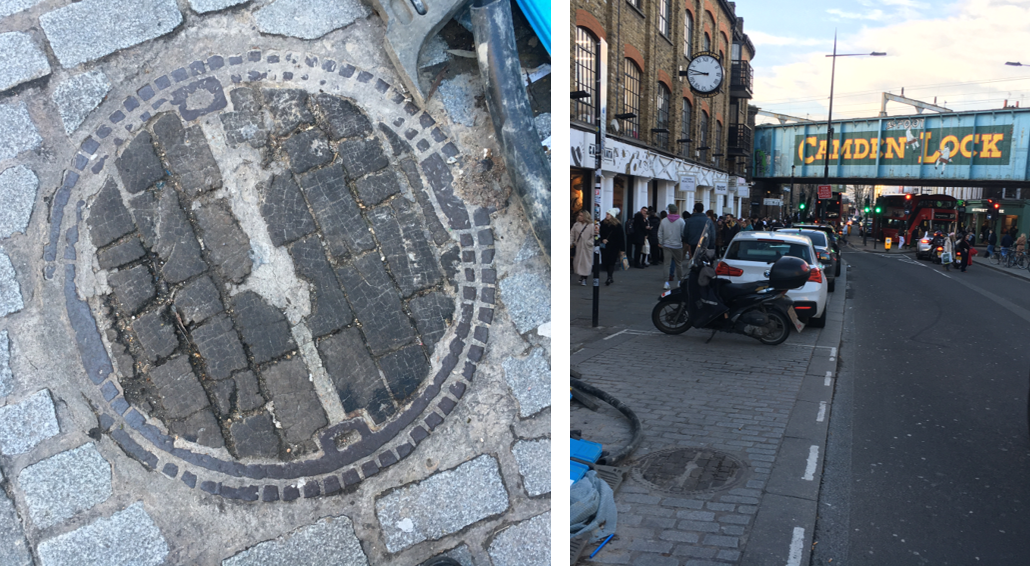
You might have already seen my posts about remnants of wood block paving still in situ in today's roads. See here. This kind of surface was implemented to minimise the clippity-clop noise of horses' hooves back in the days before the motor car, yet here and there on today's Tarmac'd streets you'll see small patches of this old surface type, though mostly within man hole covers or on private forecourts.

I'd been told there are some examples hiding in plain sight in Camden, and so last week, on a walk from Hampstead to Mornington Crescent, I kept an eye open for them. 


Heading down Chalk Farm Road, the first cover plate I found with rectangular blocks within it was between the railway bridge and Regents Canal adjacent to Camden Lock Market, shown above looking north. 

I then found a second one on the other side of the canal, this next pic is also looking northwards:


There are more cover plates along that western side of the road, almost evenly spaced, between the canal and the tube station. 

Another woodblocked example can be found on the corner of Inverness Street, viewed here from outside Offspring shoe shop:

I thought I'd found four examples, but when I got home and looked at my photos it seems I only took pics of three of them. Camden is always so busy, it's hard to see where you are going, let alone go on a woodblock hunt. 

The man hole at the end of the road, opposite the tube station, almost at the junction with Parkway, is infilled with Tarmac. I did a quick search around the junction in the hope I might find some others but, no.  


I'm sure there are more to find in this busy zone. After all, with the amount of distribtuition going on in this vicinity, plus Gilbey’s stabling and tunnels linking the various buildings, today converted into subterranean market spaces, there surely must be many more pockets of wood paving here are there. Woodblocks would have been prevalent here to assuage the noise of all those horses’ hooves. In due course, I’ll go for a wander around the market areas as I am bound to find something. I'll update you if and when I find more evidence.

………

Update August 2023: I have set up a London A-Z Directory of Woodblocks. If you can add to the list, please leave a comment under this blog post or email me at jane@janeslondon.com

28 November 2022

More wood blocks street paving in London and further afield (part 3)

In April 2021 I wrote piece about areas of wood block paving still visible in London. These I'd found mostly in the Clerkenwell, Islington, old Finsbury and Shoreditch areas, plus the large remnant at the south side of County Hall. I followed that up six months later with an update, adding other sightings in Southwark and Islington along with a panel in an alley off Clerkenwell Rd that I did indeed go to look at in person, and I did take more pics, but what have I done with them?!  

Well, since then I have spotted some more, and one of them was just a couple of days ago, a few minutes' walk from my home in Holloway N7. I was crossing the junction of Holloway Rd heading west and standing on the central reservation directly in front of Barclays, now closed and empty, and looked down to see this wood-filled manhole:

How, had I not seen it before?!  In my defence, I rarely ever cross the road at that point. Here's the Google Streetview of that location, looking back from Barclays to where I was standing. As you would expect, I then made a search of the whole junction to see if there were any others in the vicinity, but no. 

So I came home and added my photos of my new find to my 'Wood Blocks More' folder which contains, in no particular order... 

Within the covered entrance to Bermondsey Leather Market on Weston Street:

A couple in Hampstead, NW3:

Further afield, outside London, I found a lovely example in Waltham Abbey: 

And in Whitstable there is a paved floor within the gatehouse entrance to the castle gardens:

Someone told me they saw a filled manhole cover in Chalk Farm Road, Camden, but whoever that was didn't take photos or provide me with any more info. I've just been up and down that road onscreen via Google Streetview but I can't find it. I'll have a proper look next time I am visiting the markets.

I'll leave you with a pic of one of the first examples I ever spotted – I cannot believe that I omitted to include this one, as well as the other two that are very near here, when I compiled my initial post on this subject back in April last year. Unusually, this is not in the road but instead it's set within the pedestrian pavement outside Pizza Express, Upper Street, Islington, hinting perhaps that the road used to wider. Here it's looking lovely after the rain and I think the outer shape resembles the London Underground roundel: 

Re the other two nearby, they are actually in Islington High Street, behind the old tram electricity station, today an Amazon outlet. One is still intact see here, but the other one a few metres south on the No Entry sign near The York pub, was infilled about two years ago. I do have some pics before they slapped it full of tarmac and when I find them, and the photos in the Clerkenwell alley, and the Camden example, I will compose Part4. Ooh the excitement, ha ha!

………

Update August 2023: I have set up a London A-Z Directory of Woodblocks. If you can add to the list, please leave a comment under this blog post or email me at jane@janeslondon.com