Showing posts with label 1930s. Show all posts

27 January 2026

The names behind the letters on 161-167 Euston Road

I have lost count how many times I have looked at the building at the corner of on Euston Road and Upper Woburn Place, today occupied by Prezzo and Barry's Bootcamp, and wondered what on earth the letter N in the metalwork signifies. It's been on my To Do list for decades, so here goes... 

Here is the view from Eversholt Street with the portico of St Pancras New Church on the left:

Having just searched my archives for some pics of the details, it appears I have never taken a photo of this building, so all the images here are screen shots from Google Streetview. This is probably because I usually question the Ns when I have just gone past on a bus, having missed hundreds of photo opportunities. 

The next image shows the Ns within the fancy the metalwork, painted light grey-green. There is also a scripty B above the door to the restaurant at the corner:

The B is for Barclays Bank – I have seen Barclays Bs on other buildings, such as not far from here at 236-240 Pentonville Road where a second door has a letter T above it denoting Telephones/Telegraph office. They might well have had one of those 'You can telephone from here' signs outside. Barclays and the Post Office often occupied the same spaces. Coincidentally, here in Euston Road there is a huge telephone exchange next door constructed in the early 1930s (one of many exchanges in this area).


The view above, from the church across Upper Woburn Place, shows how impressive this building is. The elegant design continues on all three sides. At the corner of Endsleigh Gardens there is a similar corner door to the Barclays bank entrance but the embellishment contains no letter and has been painted black. A semi-circle of fancy metalwork is still in place:


At street level along Endsleigh Gdns there are elegant columned supports between which would have been, I am sure, display windows, today infilled with smaller windows:


At the western end the access for delivery vehicles is now also mostly blocked.

So, what do the Ns signify? 
Well, it turns out this was a company called Nettlefold & Sons, ironmongers. The company's address is shown as 163 Euston Road, today the entrance to Barry's Bootcamp, although I think Nettlefold's showroom and offices would have been accessed by the rear corner door.
Nettlefolds was founded at 54 High Holborn in 1823. They became famous for the quality of their screws used for boat and bridge building, manufactured in Smethwick. Almost 100 years later, in 1928, they moved to this Euston Road address which, I assume, due to its Beaux Arts style, was already constructed when the Nettlefolds arrived. 


The entrance to No163 later became access to the post office and Euston telegraph exchange next door. The 1939 directory shows that this door was also used by a Scottish life assurance company and Asprey & Co, goldsmiths.

N is for Nettlefolds. 
The strange this is, considering I have a bulging folder of photos of ironmongers' and founders' marks on coal hole plates, railings and bridges, I had never before heard of Nettlefolds until today, nor seen evidence of their work, probably because they made component parts often hidden from view.

Also, see the comments section below for how the company was absorbed into GKN – thanks Anonymous! 

20 April 2022

Criminal loss of curved Art Deco windows at Balenciaga, New Bond Street

I am often to be heard talking about how surprising it is that many of the marvellously constructed and well-embellished buildings along Old/New Bond Street are not listed at least Grade II. This, I assumed/hoped was because the kind of companies who trade here are aware and proud of the beautiful buildings in which their products were being sold and they simply look after the heritage they inherit. Indeed, one only has to look at the excellent revamp by Victoria's Secret at the northern end of New Bond Street, where many of the modern shopfittings installed a decade ago were cleverly created with modern products to appear as if they have been there since the 1930s. The outside of that building is stunning, never mind the gorgeous glass staircase inside.  

But this post is about what I believe is criminal damage/wanton destruction at 24-25 New Bond St, on the corner of Conduit Street, where beautiful, possibly unique, curved windows at ground level that meandered in and out of the supporting columns as a wavy curtain of glass, shown above (Google Streetview screengrab) are no longer there.  

Form the late 1930s, this building used to be home to C. J. Lytle Ltd, as shown by this marvellously evocative pic from 1948. More recently, until 2020, it was a branch of Russell & Bromley who made excellent use of the undulating glass as shown in the Google streetview pic above. When R&B moved out, the windows were individually covered, as shown in my pic below from Feb2021. Phew, I thought, the are being protected, they'll be fine.

When Balenciaga took over the building they installed big bright green hoardings around the curtilage (I love that word!) as shown here in June2021. I continued to naively assume that this was to protect the lovely windows, that they were simply performing a bit of TLC behind there. I mean, who would remove what surely must be some of the best curved glass in London? 

But last Easter weekend, whilst walking past, leading a guided tour, I stopped in my tracks, exclaimed, "No!" and then had to explain to the group why I was so shocked, even though this was not the subject of the walk on that day.

The gorgeous curves and undulations have been removed and replaced. The windows are now flat plate glass and the columns have been boxed in. Balenciaga are so proud of their new boxy space that on their website here they call this 'a treat' – I call it a 'blandification' and I think Villanelle, that character in BBC's Killing Eve who has been pictured sporting Balenciaga's expensive boots, would call this renovation "BORE-RING!"

It's amazing that Balenciaga didn't go the whole hog and install chickenshop-style UPVC doors and windows as this is barely a step up from that. I am so upset. But you understood that paragraphs ago(!).

It occurred to be that the gorgeous glass curves were very similar to other excellent shop fronts created and installed by Pollards such as here and I was hoping that when those green hoardings came down I might be able to find one of Pollards' patent marks embedded in the metal edges. But now that's not possible. And, to add insult to injury, I was convinced that I had taken some good close-up photos of those curved windows a while back when R&B was still trading here, and was hoping that I could include those images as slides for one of my online talks about Art Deco buildings, but now, frustratingly, I now cannot find them. Let's hope they show up and it's just because I simply didn't get around to naming the files. 

Update March2026– I still haven't found those pics. But here's a curve-ball... I have found evidence of the corner of Conduit Street in 1948 here on RIBA pix, which clearly shows that the curved windows were not a pre-war concoction. It shows that Russell & Bromley were already there at that time and they must have installed the undulating glass at a later date, I know not when. 

It's a huge loss when cleverly-designed bespoke elements are renovated or removed. A similar example can be found at No.1 New Bond Street at the Ralph Lauren flagship store, a building that resembles a Byzantine-style palace which, in 1939, was home to The National Provincial Bank, F.W.Woolworths, CondeNast publishing, and offices of the aforementioned C.J.Lytle advertising before they moved to the Balenciaga site later that year. Today the Ralph Lauren store sports plate glass at street level but here's a link to how it used to look in 1955. I do not know when the ground floor windows were altered, although many buildings of this type suffered blandifications in the 1960s and 1970s in an attempt to remove what was then seen as fussy embellishments. A similar thing occurred at the Louis Vuitton store, on the corner of Clifford Street but, on the plus side, LV must be commended for a revamp a few years ago when they altered the lower external façade to echo the designs within the upper floors, which is marvellous.

Let's hope that the curved glass windows have been repurposed elsewhere. If I find out more, I will add to this post.

The Balenciaga and the Ralph Lauren buildings feature on my Burlington Deco guided walk which is all about the shops, clubs and designer goods of the Jazz Age and 1930s. 

1 February 2022

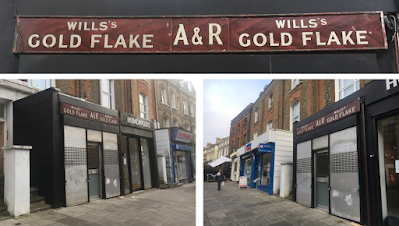
Reveal of old Wills's tobacconist sign in Hornsey Road, N19

Earlier this year, as I was exiting the Post Office at Hornsey Road, I spotted a lovely old shop fascia across the road at No.526, advertising Wills's Gold Flake.

I crossed the street to take a closer look. It's in fantastic condition, so I wondered if it was an old sign that has simply been protected by subsequent layers or a modern pastiche. I took some snaps with the idea to do a bit of sleuthing.

Passing again a few weeks later, the door was open and I saw a fella working inside. He came out to chat to me and told me that he/they had found the sign under the modern one here whilst pulling apart the layers of adaptions during renovations and they fully intend to keep the sign. How lovely. We talked about the tobacco brand and how lovely the sign was but I completely forgot to ask his mname or enquire what kind of shop this will be. I will update this when I do know.

So who/what was A&R?  This could be the name of the people at this location, or a chain/franchise. The old street directories show that this was a greengrocer's shop in the early part of the C20th, run by Daniel Arthur Colby until 1914. The shop was ten empty for some time during WWI because nothing is listed for the period 1915-19 and I have no refernece beyond that. But I suspect the shop became a tobacconist in the mid-1920s. I can confirm, however, that by 1939 it is the business Mr. Herbert John Ranson who could quite possibly be the 'R' of A&R.

It's great to see this area of N19 finally evolving. As someone who has lived near here for over 30 years I have seen the shops become neglected in this island twixt Archway, Crouch End, Finsbury Park and Holloway. Hence there are quite a few interesting old bits of signage to be found herea and it's great to see so many new finds being preserved. For instance, across the road from this Wills's sign there is the old Hancock/Plumb butcher's shop that I have written about here. Further down the hill, south of Hanley Road, there is this old grocer's sign advertising tea at the rear as well as many more hints of the past here.

18 August 2021

Remembering Romford market in the 1960s, 1970s and 1980s

In 1964, when I was two years old, we moved from Dad's family home in Becontree, into a house in Albert Road, Romford, Essex, 17 miles east of central London, in the London Borough Havering. 
During my school years this was a part of Outer London Education Authority (OLEA). Today I notice that Romford is classed as London. It seems that these days anywhere within Transport for London's travel zones is considered to be part of London. But when I was at school, we never thought of Romford as was London. We lived in Essex. We went to London. Catching a train to go into the big city was something you did occasionally for a special day out with the family or friends.
Elderly members of Mum's family told us about when they were young children in the 1900s and the town was little more than a cattle market town surrounded by fields. There followed a fair bit of expansion and new build in the 1930s but that was just a few shopping arcades and terraces here and there, a couple of cinemas etc. The pic below is from a book that used to be my granddad's, but it's not dated or credited. I think it could be late 1930s as it does show some buildings of that era. 

 
It shows North Street at the top and South Street continuing from it, cutting a diagonal from top left to bottom right, with St Edward's church at the north side of the market, just above centre. The area shown below the market and the church, was later demolished when an area twice what's shown here, was flattened and replaced in the 1960s. A few decades later, most of the buildings to the left side would also be demolished, including those that made up the Ind Coope brewery.  
As a young child in the late 1960s, I recall mum being really disappointed about the ring road that was built to be around the central shopping zone. Many buildings were subsequently demolished in the name of progress. Mum, then approaching 30 years old, had lived in the area since a child herself and was saddened at the scale of the redevelopment. It was out with the old and in with the new; a bulldozer approach. She often commented that Romford had lost almost all its history with no attractive memorial, markers or statues. And, for some inexplicable reason, despite being a well-known stop on a Roman Road, a busy market town, the town wasn't even listed in the Domesday Book.  
This 13-minute [silent] video from The London Film Archives clearly shows the extent of the changes that were made at that time.
The major problem was traffic flow. By the 1960s the town had expanded from a rural cattle market to a major shopping town and the narrow streets could no longer cope with the congestion, especially at the junction of North St, South St and the High Street when buses could barely turn the corner, as this film shows. Traffic could no longer drive straight through the market to continue through into Main Road and this caused a bottleneck at the centre.
As a schoolchild, I actually remember the new shopping precinct being constructed, especially at the side and rear of M&S. A carousel was installed, probably to keep the punters distracted and happy during the mess.
The new ringroad effectively took the soul and vibrancy out of the town, making the area within a kind of dead zone after the shops closed in the evening. Only a handful of old pubs, St Edwards church and the cobbled market area remained to hint at its bygone bustling and vibrant past. This fate was to befall many of London's satellite towns during the 1960s.
The new shopping centre called The Liberty, recalling a large house that it replaced, was a success and Romford continued be the best shopping destination in Essex with the added bonus of the huge market on Wednesdays, Fridays and Saturdays, offering superb diversity and quality of produce – a real go-to place. 
A strange modern fountain was installed in at the centre, a tall structure in shades of blue above three octagonal pools, that I later used as unconscious inspiration for an art project. In later years, the structure was painted brown – they said to be reminiscent of old market crates (eh?!) but it always looked to me like a defunct outdoor swimming pool that had been transformed in a hurry. 
I must admit that, as a teenager, I used to think the naming of High Street was odd. I thought it was an odd road to nowhere with strange shops at the far end near the roundabout on the ringroad – it just didn't' occur to me that it had previously been the main thoroughfare in the past. To my mind, the main road was South Street because that's where the big shops and the station was sited. Hindsight eh?! 
By October 1980 I had a job in Covent Garden and was travelling back and forth into London five days a week. I loved working in central London; the history, the bustle, the shops, the mix of everything, the opportunities. In 1985 I was earning enough to buy myself a little starter home near Harold Wood Station, two stops further out from Romford, and I only went into Romford town centre on occasional Saturdays or before or after visiting Mum and my sister. 
Then, in 1988, I moved to Holloway, north London, to be even closer to work and my social life, returning to Romford only to visit Mum until she died in the late 1990s. I have kept in touch with a few school friends, but Romford has rarely been the place to meet.
In 2005, after visiting a friend in Gidea Park, I went for a nose about around the shops for old times' sake. Oh dear. I walked about with my mouth open, aghast at how so much further change had taken place. Mum would have been even more disgusted. I walked through to where the brewery used to be, shops arranged around a huge car park – the likes of Next, Boots and TKMaxx. It looked more like an out-of-town industrial park. My facial expression obviously gave me away because three different ladies stopped to ask if I was OK/lost!!
That wasn't a market day, and I made a mental note to return to see if the once jam-packed bustling market that I remember from my schooldays was still anywhere near as vibrant. For inspiration, I hunted online and found there's lots of pictoral and video reference to be found including these short films about the market on YouTube. This inspired me to recall the stalls I remember in the years up to about 1985. 
Starting from the High Street end and making our way to to the ring road at the junction with the library at town hall:
There was a brilliant record stall on the right, just before the Quadrant Arcade, cheaper than the aforementioned Downtown Records, WHSmiths, or Woolworths. My handsome friend Vince used to work there. Opposite, on the left side, two rows of stalls included an excellent stall for knitters offering all sorts of well-priced yarns (I was prolific and knitted back and forth to work on the train, making mohair and aran-style jumpers for friends!), a housewares stall (one of mum's favourites, tho I think she fancied one of the fellas there), a brilliant stall with knock-off 'branded' logo sweatshirts and T-shirts, etc. I particularly recall my JPS one which I said was Jane Parker Special, and the black one with a Guinness roundel.This was before I'd ever had a sip of the marvellous black stuff – I wore that sweatshirt to take my driving test, which I passed first time.
Just past St Edward's church and Wykeham Hall (marvellous jumble sales) there was a men's clothing stall aimed at the belcher chain wearing 'casuals' and I recall hearing a young geezer, in a pale blue jumper and beige slacks, ask the stall holder if he had "any of those Perry Car Din jumpers". In this zone and all the way up to the Rumford Shopping Hall on the left there were three lanes of stalls piled high with fruit and veg, and many more on the opposite side outside Littlewoods, Coles and Habitat. It was so colourful. The calls from the traders was marvellous. Free furra pahnd etc. Think of that "Morny Stannit" sketch by the Two Ronnies (which doesn't seem to be available online or I'd include it here).
Outside Debenhams, which I recall as a small child being Stones, there was a broken biscuit stall and one of the best material/fabric stalls in the market stocking fab end-of-line cut-price suitings and linens. I made lots of my own clothes back then, including lined jackets and trousers – why oh why did I not take photos of my creations and what did I do with those pieces? Then, continuing along the Debenhams side, all the way up to almost the end of the market by the Rossi's ice cream van (yummy!) there was an excellent selection of shoe stalls. 
Oh, and I now remember Kiddie City the toy shop at the end of the entrance to the precinct – much earlier, when I was about five years old this was a cycle shop and Dad took me here to buy my first bike, a big blue tricycle with an open compartment at the rear. I cycled it all the way home, partly along Mercury Gardens which was then just a country lane/track. Today, that lane is a dual carriageway forming part of the ring road. And I have vague memories of walking past old houses at the top end of the market that then linked to little paths at the side of the Town Hall enabling us to cut through to the streets that led to grandma and granddad's house in Dorset Ave
Back to the market area. The Rumford Shopping Hall behind the fruit stalls contained many more good haberdashers and material stalls plus second hand and antique stalls. And then, within the widest section at the far end on the left adjacent to the bus stops, there were four rows of stalls offering a wide variety of things. When I was a small child, I remember seeing animals/pets for sale here; puppies, rabbits, birds, small reptiles, etc, but by the 80s these were long gone. The end of the market today looks like this but this pastiche construction was not there when I lived in the area. I recall large wooden construction with ads pasted onto it. I am sure it was a sort of muddy green/khaki colour framed in white – it doubled up as sheds for the traders' stall frames.

Well, it's taken about 17 years to get around to another visit, specifically on a market day. This was brought about by one of my online talks via Zoom which is about street markets in central London and how they have diminished, adapted, or disappeared completely as our shopping habits have changed. Conversations after that talk have provoked discussions about markets on the periphery of London and how Romford was one of the best. On Saturday 14th August I made the pilgrimage. I met up with a couple of ladies who have attended my talks (nice to finally meet them in the flesh!) and we were joined by one of my schoolfriends who lives in Rush Green.
Here goes... Actually, no... I've changed my mind... I keep remembering more things... this is already too long and I have lots of pics to sort out that I took on the day. I do the 2021 update in a separate post.