Showing posts with label shop signs. Show all posts

18 June 2026

Drop shadows – up, down, left or right?

Yesterday evening I presented a talk for the Letter Exchange at The Artworkers Guild on Queen Square. The subject was The Signwriters of Old London and I shared with them my observations and research about some of the people and companies who created beautiful carved and gilded shop fascias or hand-painted ads on buildings. 

The Q&A after the talk was really good and one person asked about drop shadows on letters. He suggested that here in the UK we tend to apply the shadows on the other side to those he'd seen in Germany. I responded that I've seen this applied on both left and right sides here.  

Intrigued by this notion, and wondering if there were more signs dressing to the left or right, I've looked within my picture archive. Here follows a random selection of screenshots showing that there is indeed a winner.

I’ve grouped them into two sections. This first batch shows the 3D/drop shadow effect at the bottom right, making the letters look like they are standing out above us, as if we are looking up at them:


The next ones show the shadow falling to the left:

The drop shadow to the right wins with 20, compared to 6 to the left = approx 75% of the signs. However, I do notice that half of the latter section are post-war era. I wonder what that's about?!

But here's an oddity – at Lloyd's old dairy the name above the door has the drop shadow at bottom left, yet the script along the adjacent windows is the other way:

I think the drop shadow choice depends on the style of letters employed because the words/names need to be clearly legible. It was suggested last night that it was quicker and cheaper to produce the shadows from one direction which I think must be to the left because, with most letters having a vertical on the left side it is quicker/easier to achieve – for instance, using the Lloyds sign above as an example, if the shadows went the other way the internal of the vertical on the letter L would need to be rendered as well as small end of the bottom bar. Plus there's that curve on the D.

To illustrate that a shadow in any direction can produce different results, I have cobbled together these rudimentary examples, the bottom two showing the letters dropping down towards us:


What do you think?

6 October 2022

Colourful Islington shops

Walking along Camden Passage, Angel, Islington, on Sunday, I stopped between two colourful shops that face each other and mused how the zeitgeist at the moment is to slap a bright or gaudy colour right across the whole shopfront; woodwork, pipes, fascias, the lot. 

Here they are at the top with a selection of eight others from Upper Street:


4 April 2022

Another shop fascia reveal – this time at 237 Upper Street, opposite The Union Chapel

So there I was, leading a guided walk down Upper Street last Thursday 31st March. The subject was 'Islington's Golden Mile – drapery, corsetry and fancy goods' all about how this busy thoroughfare used to be lined with beautifully gilded shop fascias, curved glass and the like. 

I positioned the group twixt the two parts of Compton Terrace Gardens, intending to talk about the tall early C19th Georgian buildings along this stretch, and long-gone emporiums that once filled the lower parts. I looked across the street and noticed a newly-uncovered shop sign three doors north of Laycock Street, where once was a lurid green sign, see right. Wow! What a nice surprise. I had to explain to the group that this was the first time I'd seen and I was sure I hadn't spotted in that past week.

The gilded letters tell is this was (? high class?) F. Horn & Sons, furniture stores and, having checked, I can tell you that the Horns were at this address for a short time from/around 1910, having taken over a site previously occupied by Harry Joel, fruiterer, part of what had been Whittards hosiery store at 237-238 (the Whittards evidently contracting rather than expanding at this time). In 1915 the Horns are shown at 236-237, which includes the shop to the left.

If you look at bottom right you'll see the signwriter's name which reads, Clang & Sons, 239 Goswell Road. This is very intruiging – I might be going word-blind here looking through all these old directores, but I cannot find a reference of any signwriters at that Goswell Rd address, or any Clangs or C.Langs in that profession during the period 1910–15. Very strange. There is a chance, being as there is no number on the sign, that the Horns brought their expensive gilded sign with them when they moved here from elsewhere. I cannot say how long the Horns traded at this address as I don't have enough reference to hand. 

The later sign painted over the top looks to be interwar era when the shop is again offering fresh produce, as is shown by the script, Highbury Fruiterer. This could be, perhaps, John Oliver listed here as a fruiterer in 1939.

As, ever, do let me know if you have any further info.  Here's nother pic:


1 February 2022

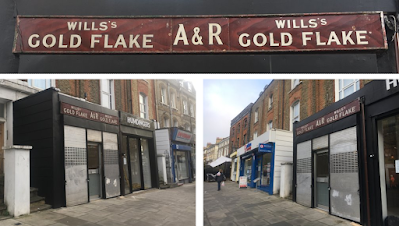
Reveal of old Wills's tobacconist sign in Hornsey Road, N19

Earlier this year, as I was exiting the Post Office at Hornsey Road, I spotted a lovely old shop fascia across the road at No.526, advertising Wills's Gold Flake.

I crossed the street to take a closer look. It's in fantastic condition, so I wondered if it was an old sign that has simply been protected by subsequent layers or a modern pastiche. I took some snaps with the idea to do a bit of sleuthing.

Passing again a few weeks later, the door was open and I saw a fella working inside. He came out to chat to me and told me that he/they had found the sign under the modern one here whilst pulling apart the layers of adaptions during renovations and they fully intend to keep the sign. How lovely. We talked about the tobacco brand and how lovely the sign was but I completely forgot to ask his mname or enquire what kind of shop this will be. I will update this when I do know.

So who/what was A&R?  This could be the name of the people at this location, or a chain/franchise. The old street directories show that this was a greengrocer's shop in the early part of the C20th, run by Daniel Arthur Colby until 1914. The shop was ten empty for some time during WWI because nothing is listed for the period 1915-19 and I have no refernece beyond that. But I suspect the shop became a tobacconist in the mid-1920s. I can confirm, however, that by 1939 it is the business Mr. Herbert John Ranson who could quite possibly be the 'R' of A&R.

It's great to see this area of N19 finally evolving. As someone who has lived near here for over 30 years I have seen the shops become neglected in this island twixt Archway, Crouch End, Finsbury Park and Holloway. Hence there are quite a few interesting old bits of signage to be found herea and it's great to see so many new finds being preserved. For instance, across the road from this Wills's sign there is the old Hancock/Plumb butcher's shop that I have written about here. Further down the hill, south of Hanley Road, there is this old grocer's sign advertising tea at the rear as well as many more hints of the past here.

21 June 2021

Goodbye Habitat Tottenham Court Road – but let's save Pollard's curved windows

Heading down Tottenham Court Road on a bus in early March this year, I noticed that Habitat had moved out. Oh dear. I got off the bus to take a few snaps. The exterior signage had been removed and the interior was being stripped. The lovely curved display windows that run around the shop on both sides were covered in dust. 


The windows around this part of the building are double co-joined curves – an expensive innovation, but this design allows the products to be seen clearly rather than be hindered by reflections from the street. The glass would have been installed in the late 1930s by Pollards, the go-to shop-fitting company of that era who had 'imported' this curved glass idea from the US. 

I went back in April and took some more photos. With all the furniture removed this gave clear views across the store space of the windows. Really good infitity shots are to be had from the exterior where mirrored end panels along the top sections repeat the curves.


I recall that the curved windows used to continue all the way along the full frontage – these were replaced with boring sheet glass c2000. I didn't take pics or note the specific date but I did find a photo ref of that somewhere – when I re-find it I will add it to this post.

There are only a handful of places in London where Pollards' unusual horizontal curved glass can be found these days and each install is unique... 

Fox umbrellas, at London Wall, Moorgate, was established in nearby Fore Street in 1868. As I understand, this is the first site where Pollards' curved glass was installed. It's really hard to photograph, especially when the place, which is today a cafe bar, is closed during lockdown or open with people sat at tables outside on the pavement. 

The double curves at the Fox shop here are shallower than at the other sites. I haven't a clue what those blobby bits of art in the window were supposed to be! At the extreme right end of the hand rail there is an imprint showing Pollards' non reflecting window patent numbers.  


The shop also retains many of the early C20th interior wood fittings. Pre-this Jazz Age refit, the display windows would have looked something like James Smith & Sons, New Oxford Street.

And then, of course, we have what is possibly the best-known example of these windows at Joseph Emberton's marvellous building for Alexander Simpson, a stone's throw from Piccadilly Circus. It opened in 1936 selling Simpson's range of men's clothing and is today home to Waterstone's bookshop. Here we a have two sets of single deep curves, again with the mirrored ends. During the Christmas 2018 period part of the windows were damaged and suffered huge cracks, as shown below protected by thick adhesive plasitc sheets. This being a Grade I listed building, the glass has since been replaced. Phew.
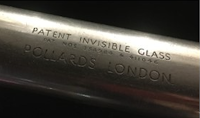
As per the Fox shop, on the hand rails on the Piccadilly-facing windows, Pollards name and 'patent invisible glass' can be found at both the extreme left and right,  rather than 'non reflecting' as per the Fox shop' along with two patent numbers can be found. 

More about Pollards in italics at the bottom.

Joseph Emberton's beautifully-designed building for Simpson has, in effect, two front doors – the southern entrance in Jermyn Street is just as impressive, implementing the same curved glass and showing that both entrances were of importance as regards customers, but I cannot find a patent mark on this side of the building:

The fourth/last London example, unless someone can tell me where to find others, is on the old gas showroom on Crouch End Broadway, today home to Barclays Bank, where double shallow curves meet and point towards us along both sides of the building. No Pollards markers to be found but there's some really nice Art Deco geometric metalwork at low level.


At high level, this building also features eight beautifully-carved panels carved by Arthur Ayres depicting the many different things that gas power could do for us.

Edward Pollard, shopfitter, company founded 1895. Listed at 134E+F Kingsland Rd, E2, as E.Pollard. 1906 moved to 29 Clerkenwell Rd. In 1913 E. Pollard & Co. designed and fitted Carreras Piccadilly shop. c1919 built a factory in Highbury. 1920s showrooms at 299 Oxford St (branches in Bristol, Manchester, Glasgow, Dublin). By 1923 E. Pollard & Co.Ltd also have second Clerkenwell premises at 158-187 St John St (Hammond+Champness lifts building, rebuilt 1925-27). 1967 Pollard Group relocated to Basingstoke.

UPDATE: see the comments for reference of similar curved glass at HMV, 363 Oxford Street, which I have written about separately here. 

UPDATE 2: A photo of the Piccadilly store shortly after it opened can be found in Art Deco Style by Hillier and Escritt. Here is crop of the street level area of that image:

It seems to show curved pairs coming forwards as at the other locations, and I am now thinking that the deep curve we see there today, that swoops away from us, was installed at a later date. Intriguing.

16 January 2020

Update re doorway mosiac in Caledonian Road

A while back I wrote about this doorway in N1.
I completely forgot about it until I was looking in the directories for something else along The Cally and found that for at least 1915-39 this was a branch of Frost or Frosts or Frost's*.
This local grocery chain was not as common as say Lipton's, Sainsbury's or Home & Colonial Stores but they did employ the ubiquitous Victorian script style for their 'logo', as per Boots and CocaCola.
I discoved the name Frost at the Cally Rd location – er, why hadn't I checked theis before?
This reminded me of the lovely old shops I photographed Wandsworth which includes this one:
Doorway mosaic, 114 St John's Hill, Wandsworth
Further sleuthing... here's the full list of their shops in 1939:


And I found an old pic of how one of their stores might have looked – I am guessing c1910:
Frost's Stores, location unknown
*My [pedantic?] eye for detail has spotted that the possessive apostophe and/or plural name isn't consistent. As you can see from the 1939 directory, above, they are listed as 'S. Frost & Co. Ltd., provision merchants, yet for the specific Wandsworth entry in the same directory they are shown as 'provision dealers'. I am not about to check them all...!