Showing posts with label ironmongers. Show all posts

26 October 2025

More fancy filigree 4-sided forged fencing

Continuing from my last post about an unusual gatepost in Notting Hill, it's no surprise that I have since been scrutinising any similar forged railings and gateposts to see if they sport the same name. 

Whilst I haven't as yet found any more Yates/Haywood marks (calm down, it's only been a fortnight!) I have spotted some other lovely examples of fancy metal boundaries around Regents Park, in particular these beauties in St Andrews Close, a cul-de-sac adjacent to The Royal Society of Physicians:


Each of the four-sided posts tells us they were made by Peachey of Regent Street. There are more fancy railings just around the corner, on MaryleboneRd at the corner of Peto Place facing Gt Portland Street station – the plinths bear the name of May Morritt:


Having just looked in Kelly's 1841 street directory, John Peachey, ironmonger, is listed at 69 Regent Street along The Quadrant here but not within that actual building, the street having been rebuilt in the early twentieth century. Peachey's neighbours included a wine merchant, a carver and gilder, a hatter, a wax chandler and another ironmonger at No. 77 in the name of Thomas Wilkinson. 

It occurs to me as I write this that I have never seen the names of Peachey or Wilkinson on any coal hole covers (ditto Yates/Haywood) which suggests, due to their rather posh addresses, that these two businesses targeted the upper classes, offering bespoke decorative ironmongery for expensive properties, rather than functional items used by the staff, such as tools, coal scuttles and cover plates. 

It's a similar story with May Morritt of 66 Oxford St which is also long gone. Their ironmongery shop, later No.140 when the street was renumbered, was three doors west of Wells Street, adjacent to Adam & Eve Court. The block has been redeveloped many times and is currently a construction site (again) – here's a streetview link to when it was a Burton/TopShop. I am assuming this was was two men, Mr May and Mr Morritt. theirs was also not the only shop of its kind in the immediate vicinity. A few doors along at No.79 there was Mr Robert Parkinson, ironmonger, and White & Sons were on the opposite side of the street at this time, to name just two more examples. As you can see in that last link I've found a few different coal hole cover bearing the name of White & Sons, or similar, theirs being a shop selling all sorts of household requisites, but no covers as yet found showing May, Morritt or Robinson. 

It seems odd to us today to think that shops selling ironmongery of any kind would have been located on major shopping streets that today are known for selling mostly clothes, accessories and coffee, Indeed, by the early 1880s this had already become the case with almost all of the shops along these main thoroughfares offering more personal items such as shoes, dresses, tailoring, tobacco and jewellery.

I'll keep looking for more fancy filigree. But, you know I will.  

This post can also be found on my Janeslondon Substack 

19 September 2022

More coal hole cover plates – this time in Marylebone

Last week I was looking up at demons and here I am looking down again, but it's far from gloomy... 

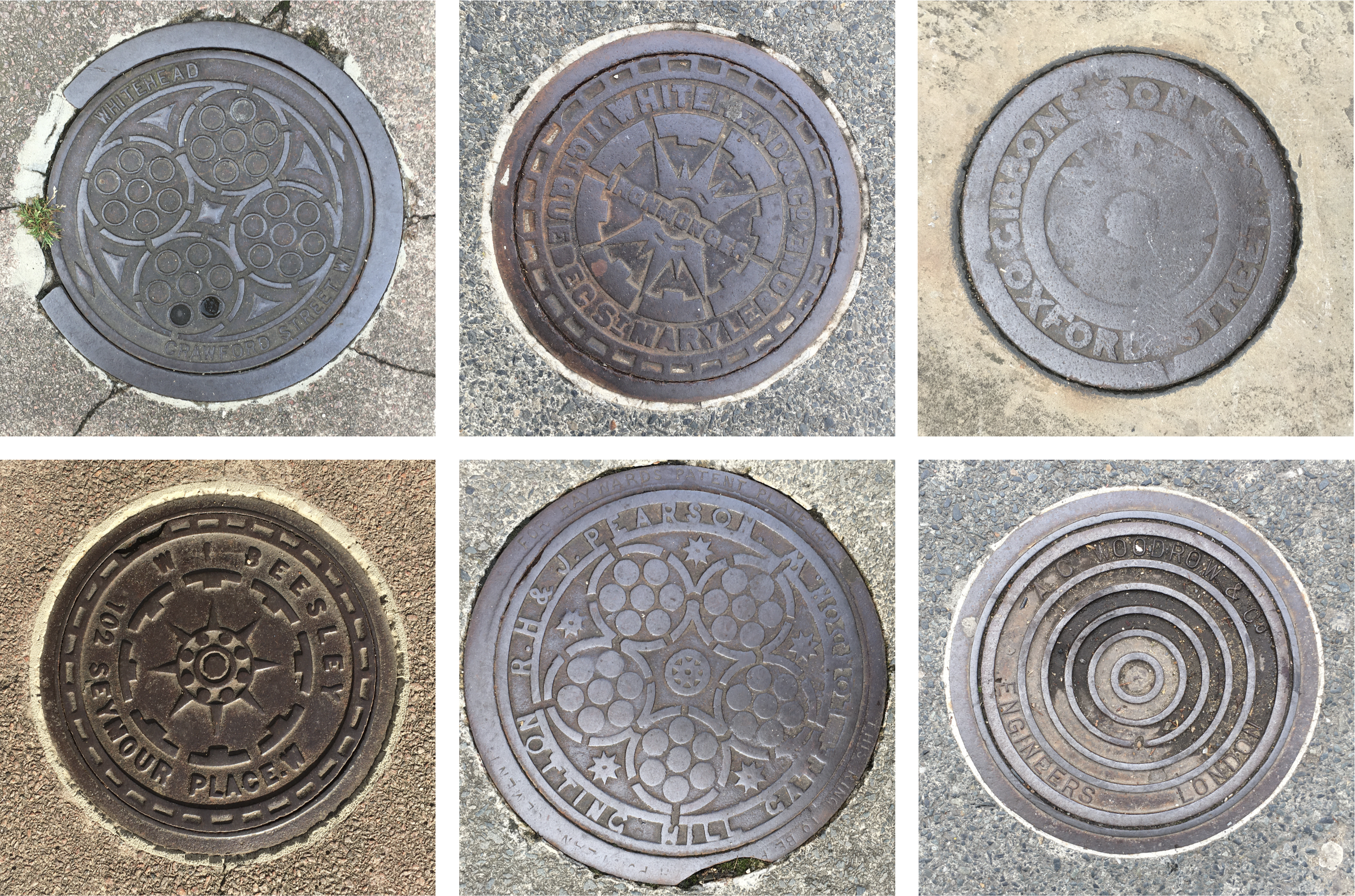
I was recently on a mission to check up on some 'Art Deco' buildings in the area between Marylebone Station and Baker Street when I happened to spot a few coal hole cover plates with names on that I was sure I hadn't seen before. The one that first caught my eye was in Balcombe Street almost at the junction Ivor Place and it bore the name 'Whitehead'. I took a snapped a quick pic and was about to continue my journey when I noticed another plate a few metres away with the same name but a sporting different design (see below, top left and middle). Hmmm... I scanned some adjacent plates and noticed the diversity of names, a couple of which I was convinced weren't in my mental database. 

Oh gawd. What to do? Continue with PlanA or let myself get distracted by this new project? Of course, I went for the latter. 

From the Ivor Street junction, I walked northwards keeping to the left/west side of Balcombe Street, then at the top I crossed over to the other side and went back down to where it the street meets Dorset Square. I then did a circuit of the square and went back up the left side of Balcombe Street to complete the full loop, ending back at the Whitehead plates.

I have endeavoured to show the plates in roughly proportion to each other here. Most residential plates are the smaller 12" ones (excluding the outer ring), though I did snap a couple of the larger 15" ones which are more usually seen outside larger establishments such as pubs or restaurants and this hints to me that some of these houses here, being a stone's throw from Marylebone Station, were hotels. Indeed, I didn't check to see if they might still be. 

A few of the plates here have holes within the designs to allow ventilation within the coal cellar below. These are evidently part of their manufacture, but I have seen many examples elsewhere where holes have been retrospectively drilled in a random fashion by people who clearly have no regard for the design!  The three different Matts plates (below) show how that company's name and address has evolved in many ways.

Notice how in some cases the patterns on the covers are the almost identical. This is simply because the ironmonger's name has been added to a pre-made mould that was already available at the foundry. However, some of the more successful and wealthy ironmongers had their own bespoke, and therefore identifiable, designs created, as per the Gibbons plate at the very top and, although the initial process would have been expensive, repeat orders from that mould would be the same price as the off-the-shelf ones.

Unusually, compared to other streets of this era, there is no clear single winner amongst the range of local ironmongers shown. Elsewhere, it's evident that one local business has been engaged to supply the plates for a whole terrace having been contracted by the developer or contractor when the houses were first built. Instead, in this part of Marylebone, there is a mix of all sorts – some show local businesses in Marylebone, Edgware Rd and Lisson Grove, but others come from further afield, but only a few miles, as can be seen by the streets and locations on them. There are, of course, quite a few sporting the name Haywards of Southwark, the company being the B&Q of their day. And, without going back to count them, I'd guess either Sampson of Euston Road or Matts of Paddington were the two most common local names in this vicinity, with Stone coming in 4th. 

Something else I found in Balcombe Street that I don't think I have seen before... some HUGE slabs of York stone paving which I estimate are almost the size of a double bed.  

At the top end of the street, north of Ivor Place, on both sides of the road, some unusually large pieces of natural stone sit above the coal cellars as street paving. These super-size slabs must have been really expensive and I wonder how they were transported and how difficult it was to install them. There are coal holes within every one of them although some of the lids have been removed or infilled. I am intrigued by the ones that have been filled/replaced with strange bits of flint that looks like left-overs from church walling – something else I have never seen the like of before. 

Looking down can be so fascinating... later that day, I as good as stumbled upon a 21" Haywards cover plate about half a mile away from Balcombe Street, by which time I had run out of phone battery and it was getting dark. I will return to it soon and put together another collection.

Lots more coal holes here.

6 May 2021

Bollards in Crystal Palace

Today we are in lovely South London. Well, I say that, but I took these pics well over a year ago.

As you exit Crystal Palace railway station and head to the park, do ake a closer look at the bollards in Ledrington Rd, dated 1854. The peeling paint patterns is delightful.

The tops illustrate layers of colourful history – dark green, pink, red, blue, turquoise and yellow, though not necessarily in that order.

It's about time I went back for another wander – it's a lovely part of town.

27 April 2021

A stinkpipe in Islington

Oh my god... how many time have I walked past this and never noticed it until last month?

Estimate = 825 times!

I am always banging on about how things are hiding in plain view, to look up, look down and around you,  yet here's me not noticing a stink pipe across the road from Essex Road Post Office. 

I happened to notice it when I had to side-step a woman who was texting and walking but not looking where she was going (grr!) and I was immediately confronted by the maker's name on the metalwork. I then looked down at the wide base and thought, ooh that looks very stinkpipey, and so I stepped back to take a better look. Yep!

Much of Ham Baker's Victorian metal street furniture, in the form of lamp posts and stink pipes, still lines our modern streets. Indeed the company is still trading.

Considering the amount of stink pipe pics I have taken over the years I am surprised I have posted more about them. Here's a post from back in 2010 which shows some with attractive crowns

Staying in Islington, earlier this year, I also [finally] noticed another stink pipe at the Holloway end of Liverpool Road on the triangle in front of the Baptist church – estimated previous walk-pasts = 384(!). And, near that, there's also another one on Holloway Road at the end of Eden Grove (which I had spotted ten years ago).  Closer to my home, there's one up near the railway line in Sussex Way, N19, at the corner of Hatchard Rd, and another on St John's Way, N19. I'm sure I will think of more once I hit the 'publish' button here, but hey, that'll do for now.

This Essex Rd pipe will now form part of my "The Only Way Is Essex Road" guided tour. Tho, it can't be the only one in the vicinity.


3 July 2019

Goodby to Niclar House – an art deco delight

Shocking news.
On Sunday last I was leading my Art Deco Spitalfields tour and we were heading northwards up Bishopsgate. The next stop was to be Niclar house with its 1930s castellated faience tiled façade. I had already pre-warned my group that this end of the street was in the process of being renovated and that the building we were about to see and talk about had been behind nets and scaffold for the past few months – but never mind, I had pictures to show them and plenty to talk about.

Nicholls & Clarke's Niclar House in 2018 (Google streetview)
But when we got there, oh the disappointment and shock (and tongue-biting frustration):
Pic taken from the top of a bus (Sunday 30 June 2019)
Where is façadism when you really need it?
Norton Folgate sits at the upper end of Bishopsgate and has for years been cause of dispute about the conservation of its last remaining historic buildings. However, the buildings that abut Norton Folgate were not included as they did not form part of the same street – they appear[ed] to be a continuation but they actually form[ed] the first section of Shoreditch High Street, which had become separated from the rest of that road when the railway arrived.
Niclar House at No3-8 Shoreditch High Street was built as the swanky public/street-facing offices and showrooms of Nicholls and Clarke, plumbers' and builders' supplies who, since 1875, had made very good use of the adjacent railway to ship their products all over the country from their huge warehouses in Blossom Street at the rear (often used as a film location). This tiled building had repaced the company's Victorian Gothic, telling everyone that althjough they were an old company, the products inside were modern.
In June the demolition crew arrived. The bulk of the building had been reduced to rubble and The Art Deco façade was covered with scaffolding, netting and opaque sheeting and I rather hoped that it was going to be protected and saved.
But no. The powers-that-be and the greedy developers obviously don't think that unique Art Deco buildings are significant. Nor do they appear to have any regard for what's left of the Victorian streetscape. This would also further explain the loss of The Water Poet public house which formed part of the Norton Folgate Conservation Area. As mentioned above, Niclar House, being in Shoreditch High Street, was outside that half-arsedly-protected zone and hence the demolition without discussion. It will be replaced with a huge multi-storey office block* and the Norton Folgate block will be partly façaded, but only the four red brick fronted buildings. A big shame to lose an evocative patchwork of architectural history.
I wonder what happened to all those lovely 1930's tiles and the clock parts? Were they saved and sold on? I hope so.
Also see The art deco clock.
Nicholls & Clarke still trade today
 
*I feature this building on my Demolished Art Deco – Gone But Not Forgotten online talk via Zoom – see Jane's London Walks for more info. 

29 January 2019

Primrose Hill coal hole cover plates


Out wandering about in Primrose Hill the other week I noticed quite a few unusual names and designs on the coal hole cover plates embedded in the pavements there. Most cover plates have patterns on them to stop them from being slippery underfoot. Many just have patterns on them but canny ironmongers realised it was a good way to advertise themselves.
As you see these ironmongers are not all local to the area – Abbott of Great College St, West Bros of Marchmont St, Young of Davies St, Persons of Notting Hill, Watkins of Regents Park (the most local), Philp of Fitzroy Sq (oops, I now see I have put two of those in there!), Davies of Clapham &Camberwell, Ward of Edgeware Rd and Wood & Barrets of Tottenham Ct Rd. I didn't see any company names from addresses in Chalk Farm Road or Camden High Street, which seems odd.
The one I like best is the one that reads, Charles's Safety Plate, by patent act Vic, which I assume is a ref to Queen Victoria. This needs a bit of research. And also some better pics because the light was fading by the time I reached this terrace where almost every house had one of these outside.
Also notice the second pic which shows one of the Abbott covers embedded into two lovely pieces of Yorkstone. This is not the only cover I noticed where a feint keyhole or toilet bowl shape is evident around it. Does anyone know how/why this shape was made?
Another ironmonger, not shown in this collection, was repeated a lot in various different designs. I will post about that company sometime soon once I have put them into some kind of chronological order and done a bit of research.
See also the coal holes of Warwick Square and the contemporary ones in North Audley Street.