Showing posts sorted by relevance for query manicule. Sort by date Show all posts

22 June 2022

A marvellous manicule in NW5

The Way To Church Lands

Walking along Gordon House Road a few months ago I spotted a directional panel at low level here just to the right of the protuding block. I took a couple of crude snaps:

This manicule (pointing hand) is probably the most elaborate device of this kind I have ever seen in London. It is not simply painted onto the slab but instead has been carved in low relief complete with chubby fingers and a lacy cuff hinting at wealth and prosperity. This ties in nicely with the kind of well-to-do traders and businessmen who would have moved their families to this area in the eighteenth century – a perfect location adjacent to the open spaces and clean air of Hampstead Heath with direct access into the City via St Pancras and the New Road (Euston, Pentonville and City Rds today). For an idea of this, you need only look the impressive houses along Grove Terrace, set back from Highgate Road. 

Other words are carved into the panel at either side of the ellipse – there is a large cap N on the left and what might be '15 Feet' on the left. There may well be more at the bottom under that veil of render. 

I think the sign points to the beginning of a footpath but I cannot find evidence of that and neither can I work out which church this might refer to. It's also extremely doubtful that the sign is in exactly the same position as when it was first sited because the panel is embedded in a wall that was constructed in 1965 as part of the Haddo House development.

I will update this when I find out more info


30 May 2025

Telegraph Place and Tokenhouse Yard

Hearing Telegram Sam by Marc Bolan on the radio yesterday, it reminded that I'd taken a series of photos in and around Telegraph Place almost a year ago whilst wandering in the City of London.

These narrow little streets are accessed via Moorgate as in the pics above, or via Throgmorton Street, and they are full of architectural delights:


A hydraulic power access point outside The Telegraph public house – this might have been for the beer pumps. Further along a teeny tiny access point for the sewers. I've not seen one of these anywhere else so I am keen to know the purpose of it. Perhaps it was manually released for temporary ventilation..?
The street is so named because this is where London's first telegraph office was sited on 1845when it was originally called Founders Court (hmm ponder ponder, suggest the land is owned by the Founders Livery Co). More telegraph and telegram references here. 


The barbershop at the looks good but, until a few years ago there was a marvellous multi-layered hand-painted sign on the mirror within its Whalebone Court entrance. It's such a shame that they saw fit to scrape off all those layers of history. As you can from my 2013 photo, the letterform was a delight. It advertised a few earlier companies here including a manicule pointing down to the chiropodist below. The blue script possibly says 'hairdressers' but might have been 'shirtdressers' where you could get your collars and cuffs replaced.

Near the barbershop, two groups of stepped windows above allow light onto a stairwell, and below them an alley beneath that building leads into Tokenhouse Yard:

There are a couple of elaborate doorways in this enclosed and evocative space and both are entrances to the old GII* listed 1872 bank building – some impressive lions flank the entrance to No.12 and a similar doorway at No.11 sports a couple of fearsome fellas. I've found some pics of the interior.

Tokenhouse Yard was where the exchanging of [small value] tokens took place. Read more about the history of this thoroughfare c/o IanVisits here – I love it when someone else has done all the homework!

13 February 2022

Blooms Pianos, Kingsland Road – two signs and at least four workshops

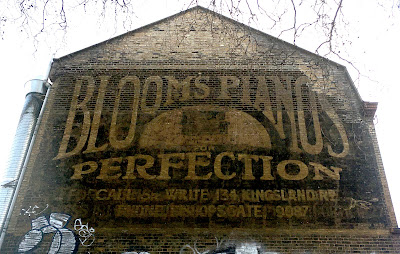
I was in Shoreditch recently, wandering about admiring things, planning walking routes and generally enjoying the Winter sunshine. I decided, as I was close by, to go and visit an old friend, the hand-painted sign for Bloom’s pianos on the north side of the block that overlooks the front garden of The Museum of The Home. 

BLOOM’S PIANOS
Illustration of upright piano within a semi-circle
FOR PERFECTION 
CALL OR WRITE: 134 KINGSLAND RD.
PHONE: BISHOPSGATE 9087 

When I got home, I tried to find out more info about its content, but available information was scant and I ended up with more questions than answers. I had read that this sign was created for/by Philip Blumher, a Russian immigrant and master cabinet maker who "spent most of the 1930s trading here" having anglicised his name to Bloom, yet there was no evidence to back up this information. And so began days, nay weeks, of bloomin' research (see what I did there?!)... 

Let's at first look at the design of this large hand-painted sign – it is clearly Edwardian/early 20th century in style as regards the letterform with those blobby serifs, undulating cross bars on the E and F, that lovely kick on the R, the curves, warps, arcs and stretches and, of course, there's that upright piano at the centre. 

Also, there are direct telephone numbers on it – exchanges of this kind did not become available until 1912, though I cannot, as yet, ascertain who the Bishopsgate 9087 number belonged to, and, despite the directional at bottom right (in the form of a manicule, a cuffed hand pointing to the front of the building), I can find no ref of any Blooms listed along this terrace in the 1910s. Though they make an appearance in the 1930s. Read on...

134 Kingsland Rd is the address of the whole block from the Museum of the Home to Cremer Street and comprises seven premises A-G. If this sign is from the 1910s then it's likely that this excellent advertising space, facing the traffic coming into London from the north, was simply used to advertise products made at nearby workshops, the sign being commissioned by an enterprising family of cabinet makers who made cases for pianofortes and had connections to someone in this block who could accept correspondence on their behalf. This might well have been William Richard Mitchell, shopfitter, who was at 134D&E in 1914, or Clarke & Greenfield, glass mould makers, at G. Indeed, in 1925 every one of these spaces is occupied by a company making or selling something to do with furniture. 
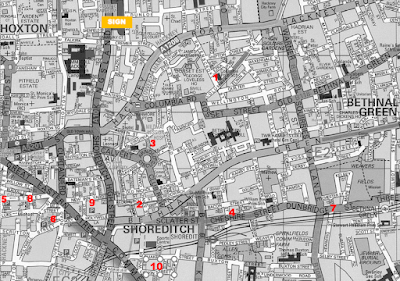
Bloom is a fairly common (adapted) Jewish name and there have been many cabinet makers by the name of Bloom living and working in the Bethnal Green and Shoreditch area. For instance, in 1899 there was Joseph Bloom at 54 Ravenscoft Street (1), a road that was mostly cabinet makers at that time, and Nathan Bloom a short walk away at 29 Redchurch Street (2). Then, by 1910 Marks Bloom is at No.64 Ravenscroft St (1) and Joseph has moved into new premises at 5 Sunbury Works, Hocker St (3). To muddy the waters further, in 1910 there was also Leckstein & Bloom in Cheshire Street (4) with other workshops in Tabernacle Street (5) and Christina Street (6), and by 1915 Jacob Bloom is working out of Dunbridge St (7), Israel Bloom is in Leonard Street (8) and Barnett Bloom can be found at New Inn Yard (9). I have no idea if they were all related, but it's very possible.
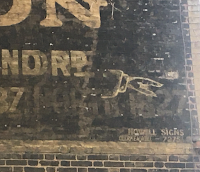
Phew! So I’m thinking this sign could be just pre-WW1 which is backed up by the signwriter’s name, written in small ‘one stoke’ at the bottom right corner: Howell Signs, Clerkenwell – 7275.
In 1910, John Thomas Howell, illuminated signs, was located at 2 Vineyard Mews, off Farringdon Road, but he’s gone from there by 1914 and I can find no evidence thus far of him being connected with that Clerkenwell phone number at that time. 

It is interesting that Howell was not local to Bethnal Green, E2, and I wonder if JTH might have been a friend or work associate of the Bloom family because I notice that Mozart & Co organ builders were at nearby 32 Vineyard Gardens from at least 1895-1910, so it's possible that the music maker connects them all, such that Mozart's mechanics might have been housed inside cabinets made by Bloom. 

The Clerkenwell 7275 phone number makes an appearance in the 1923-25 directories when Lionel Victor Howell (JT's brother or son?) is listed at 10 Penton Place, Islington (Angel area today, but classed then as part of Clerkenwell) and the phone number is carried to larger premises in the 1930s, just around the corner at what is now 91-99 Pentonville Road here.

Another idea (ooh, I am full of them!) I wonder if was J.T.Howell who painted another similar-looking sign that includes an early C20th illustration, for Daniel Leakin’s valet and car hire service at 19 Wellington Row which is on the corner of Ravenscroft Street, coincidentally a couple of minutes' walk  from a Bloom workshop in that street. It's very likely that, just like the Bloom's sign in Kingsland Road, this was initially an advertising site used to advertise services that were available close by. This is a small cottage-style terraced corner house so it's very doubtful a fleet of vehicles etc could be kept here. Until 1915 (just after I've lost track of any signwriters by the name of Howell) this corner location is shown as John Bates, coal dealer, who I think lived there and used it as his office. The vehicle depicted looks to be a 1920's Ford Model T light commercial in production 1908-27. As far as I am aware Leakin does not make an appearance here until the 1930s. But I've gone off on one of my tangents here, so let's park Daniel Leakin and his interwar motor haulage company for now and get back to the Blooms.

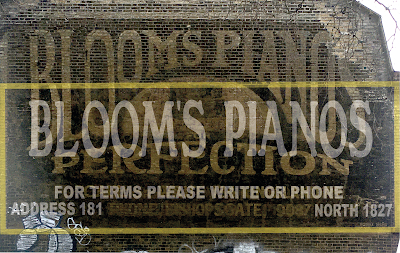
As I have hinted in the subject line, there is actually a second sign here which starts further down, sort of halfway through the big letters. If you look closely you'll notice that the lower two thirds are stronger in colour than the upper part.

I have here warped and stretched my original photo to better illustrate this. The tinted yellow box rule shows where the edges of this later sign are visible and in white I've added the letters I can ascertain thus far (though I have guessed the word 'please' at the centre).

At the bottom right there is a different telephone number from the earlier Bishopsgate one. This is confusing because, in 1939, this NORTH 1827 number belonged to George William Every & Sons, gear cutters of 49 Thornhill Road, N1, an address in Barnsbury, Islington, which is a short walk from the Blooms outlets in Caledonian Road. The Everys were in Barnsbury for at least 30 years – in 1910 they are listed as ‘clock wheel makers’ and were probably at that time supplying the Clerkenwell clock-making area. But the question here is, why on earth would Blooms be using Every's phone number? Hmm, ponder ponder... perhaps, again, this was merely for correspondence address rather than a place to buy... 

I then considered the number 181 at the bottom left corner and which road in the area might this apply to – my hunch being that it must be one of the shopping streets in the N1 area. I quickly found Blooms House Furnishers (Isaac Bloom) at 181 and 187 Caledonian Road in 1939 as well as opposite at No.198, which explains that hard to decipher part in the centre of the last line = ADDRESS 181 CALEDONIAN ROAD. (Update: I have since ascertained that  'ISLINGTON' is between the road and the phone number). 

Back to Kingsland Road and our Russian friend Mr Blumhert... 

I have been told that in 1930, Bloom Bros cabinet makers were at 134 C, D & E, but they'd left the site by 1940. I suspect this might coincide with the opening of the outlets in Caledonian Road, the Kings Cross area probably being better for transport and distribution, and also closer to the many piano and organ makers in north London, specifically in Islington and Camden, north of the canal.

There are no Blooms listed in the 1939 directory at the Kingsland Rd address. However, Nathan Bloom was, at this time, still busy at his workshop at 29 Redchurch Street (2 on the map above) and he had also taken on additional premises at 19-21. There’s also H&L Bloom at 3 Fountain Street, a premises that backs onto Sunbury Works (3) which must surely must be the same family seeing as this was where Joseph was listed two decades previously. 1939 also shows J. Bloom at 24A Calvin Street (10), within an attractive terrace of workshops which still looks good today. 

As regards the design of the ads, note that the smaller/later advertisement has no illustration. OK, so there was less space, and the inclusion of an illustration was probably expensive, but perhaps pianos, even the ones in beautifully-made wooden cabinets, were not as much of a selling point by the time this was painted, especially with domestic gramophone players becoming more affordable.

But I have an idea why the newer sign is less tall... if you study that end wall today, or look again at my pics above, notice how the bricks at the Kingsland Rd side have been replaced – the uppermost front section of the wall has been rebuilt. It occurs to me that this might possibly have been damaged during WWI Zeppelin raids – the red line on this map clearly shows that two airships passed quite close to 134 Kingsland Road in May 1915. Alternatively, if it's a1930's sign that was later repainted, this could hint at it being repainted during or shortly after damage during WW2. The date of the second hinges on when the Blooms opened those premises in Cally Rd.  I'd love to see how the wall above the thinner sign would have appeared at the time it was created – perhaps the visible elements of the earlier sign at the top were overpainted in black. 

I am still torn as regards the date/era of these advertisements. The available information is intriguingly inconclusive. The style is 1910s but the info within seems to be hinting at the 1930s which, to me, is at odds with the old fashioned letterform used. Perhaps they used a logotype in this fin-de-siecle style, hence why the letterform continued through the decades...?

I think I will stop now as I’m bloomin’ exhausted. 

Watch this space for more updates, as I will amend the info above as and when I find out more. If you can help, please use the comments box below or contact me @janeslondon via social media.

23 April 2025

Woodblocks and ghostsigns in Southwark (and a bit of Lambeth too)

Marching southwards down Waterloo Road on Sunday, running a little behind schedule to get to the start point of my own guided tour(!) I glanced to my left along Alaska Street and spotted a circular cover plate in the road. Hmm. Should I come back to this later, or check on it now? I opted for the latter and I'm glad I did.

Well I wasn't disappointed – in fact, I was elated – I have never seen a man hole cover plate of this design, let alone one so elaborately filled with chunks of wood:


The name of the company here is Post Office Telephones – I have never seen/noticed any circular plates bearing this name anywhere else. The wood is partially missing in one section and this allows us to see the thickness of the remaining pieces. Update Nov2025: that damaged quarter is now completely empty – all the wood has gone, ditto the metal nodule thing, but the other three sections look practically the same as shown above. See pics at the bottom.

Here's the view looking back to Waterloo station:


After leading my Southwark Ghostsigns walk which finishes near Borough Market, I wandered eastwards to Bermondsey to investigate the streets that abut and run beneath London's first railway line (via Greenwich). In Spa Road, not far from where the station used to be, I spotted another man hole cover between the Queen's Head pub and Bermondsey Council's old town hall building. I wiped away the bits of fallen tree seeds with my foot... 


There are only tiny bits of wood still visible within this one. It's a London County Council access point showing us that trams used to travel up and down this street when it was Bermondsey's municipal hub. It's hard to imagine that now. I had been told there were other manholes with wood blocks in them near Spa Road, but I didn't see them on this occasion. See an update below.

In Jamaica Road I hopped on a bus and headed back to Waterloo so that I could scour the streets for more wood-filled man hole covers near Alaska Street, but I found no more – it just proves that you rarely find things when you are looking for them.

I had more luck looking for cars, as there are often some lovely old vintage motors along these streets. Three old Citroens were parked in Roupell Street (though not including the 'Anthill Mob' one with running boards shown in that link) and two Morris Minors sat beautifully alone in Whittlesey Street looking like a photo shoot:


I'm glad to report that the Windmill Walk ghostsigns are still hanging on in there, barely changed in decades. I never did manage to decipher the big one which I think contains the word 'BAKER' through the middle, but the slim one is easy to read – a cuffed manicule points the way to St Andrews Church. 


Update on woodblocks Dec 2025: chatting to a friend about this woodblocks/manholes thing he identified where the other one is near Spa Road. Turns out it's a 5x5 grid cover rather than a circular plate and the really annoying thing (for me) is I had walked past it back in April after I had bought snacks in that Co-op store, duh! Here's a google screenshot taken from here.


He also told me about another one I hadn't spotted, not in Southwark, but in Lambeth, set within the triangular island at the junction opposite Morley College, where St George's Rd meets Westminster Bridge Rd, shown below and here:
 

My ever-expanding collection of wood blocks can be found here – let me know if you see any others.

Pics of the Alaska Street man hole cover taken in May 2026 – it's amazing that 6 months after I first noticed that this had an empty segment that it has not been infilled in some way – surely it is a road hazard!

18 August 2010

Filthy London

This post is sparked off by an ad on TV that really niggles me; it's for a hand cleaner that comes in a soap dispenser that has a sensor so that you need "never touch a germy soap pump again".
OK... so let's think about this... if you were to directly touch the dispenser, or the bottle, or whatever, then surely this product of theirs will eradicate the 'germs' when you wash your hands!? But how are you going to turn the tap on/off after you have applied the soap?
Actually, how did you get in the kitchen/bathroom in the first place... did you open a door? With your filthy fingers? Oh ugh!
This is all getting so ridiculous.
I recently heard one mother telling her son not to hold the moving handrail on the escalator because lots of people touch it. I don't know what she would do if the thing stopped and the poor kid fell over and hurt himself. Do you think she let him hold on when he got on the tube train? Dunno. But she probably let him wipe his dirty shoes on the seats.
And I heard another woman tell her children, who were sitting in the front seat on the top deck of a bus, not to hold onto the rail in front of them for similar reasons. Yet, when getting off, she told them to hold on tight when going down the stairs.

Top row: Angel tube station, Lavender Soap in Acton, dirty beasts in Fleet Street, Pears' Soap in Highgate Village.
Middle row: Sanitary Brixton, Holloway litter, dusty windows in EC4, manicule near Lea Bridge.
Bottom row: litter in Camden, Sunlight Soap in Highbury, door knocker in Spitalfields, dusty tiles in Old Street.

22 November 2024

Stanley Arts, Norwood Junction... plus an ironmonger, a clocktower, a ghostsign and a canal

There are are areas of London I don't know so well including the South east corner that forms part of Croydon. A guided tour of Stanley Arts afforded me the opportunity for a quick snoop. Quick, because this week has been unusually cold for the time of year – it was snowing when I opened the curtains on Tuesday morning, something I have never before seen in London in November. The following day, I wrapped up warm and travelled almost the full length of the soon to be renamed Overground line from Highbury and Islington to Norwood Junction.

On exiting into Station Place I was greeted by a magnificent clocktower with a weathervane on the top and some inaccessible public toilets below ground. I found out later that this clocktower has a direct link to Stanley Arts centre. More later.


Cold weather has its benefits, as regards lovely blue skies! I explored the immediate area and found a ghostsign for Boots the Chemist above the convenience store on the corner of Belgrave Road...


... and a couple of nice coal hole covers bearing the name J G Stidder of Boro, SE London – that's an abbreviation for Borough in Southwark, a name and cover design I haven't seen before, even in Southwark. 

Within the pavement between the Boots sign and Portland there is a panel that tells the story of the Croydon Canal which opened in 1809. I could barely read it and so took a photo to enhance it. 


This canal was news to me and when I got back home I spent quite some time finding out more about it and comparing maps etc. The canal became redundant by 1836 and has since been replaced by railway lines.
And so to Stanley Arts. Wow wow wow, what a building – a superb example of Edwardian exuberance.


It's slathered in the best examples of architectural styles of the 1900s – elaborate metalwork, niches for sculptures (mostly lost or stolen during decades of neglect), fired tiles (probably, I suspect, Doulton of Lambeth), moulded ceiling roses and decorative panels, carved wood and more... 
The building comprises three parts, basically a school, a theatre and a hall. On the exterior there is a blue plaque to the man who built it and a lovely sign with a manicule directs punters to the stage. This leads into the gallery café area past a vestibule where a recessed carved panel hints at the how beautiful this building would have been a century ago.  
  

The panel is covered in rose gold paint which I think is Hammerite, a product chosen as a quick cover-all that has also been applied to many areas in the auditorium. This paint will, over time, be removed to reveal the original plasterwork or metal underneath. 
To the right of the gallery entrance there is a staircase with some beautiful handrails above which sits the only remaining carved marble bust here. Strange how only this one remains being as it's almost in reach yet others that were sited in higher recesses within the hall and on the front of the building were removed. This example is exquisitely carved and I wonder who carved it and where the others are now?  


In the  ceiling about the gallery café area there is a repeat motif of what at first looks like a dinosaur of some kind. But look closely and see that it's a fire-breathing dragon. I doubt there's any real relevance as dragons and demons were used as decoration on many buildings during this period.


The second two pcs above are within the lovely theatre space – wooden benches and a beautiful clock that reads"Time Flies / Mind your Business" which, rather than meaning 'don't be nosey' is actually reminding us that time is precious, to manage it wisely. 
Either side of that stage there are depictions of tragedy (as Medusa!) and comedy.


Almost every surface of the building boasts embellishments in the best products of the day. Glass, marble and fired tiles changing from deep red in the theatre to green in the hall areas. The staircase up to the hall is sublime and I wonder if the fired ceramics were created by Doulton Lambeth being as the design and colours is very similar to other examples I have seen.

The final three pics with the very Art Nouveau bluebell tiles repeat are all visible from the street in the corner portico here. And, I almost forgot the clocktower – it turns out it was erected in commemoration of the Stanley's 50th wedding anniversary hinting at how well loved the couple was.  

An absolute delight. I walked towards Annerley thinking to go exploring, but being as it was sooo cold I hopped on the first bus that came along which took me to Crystal Palace station. Rather than go straight home, I took the first train and enjoyed the line to Victoria followed by a wander around the backstreets of Belgravia and Knightsbridge because I recalled the was an exhibition of Underground maps I wanted to see... join me again tomorrow for that.


30 January 2014

The changing face of Tottenham Lane

The Broadway and Clock Tower area still has a few hints here and there of it's Edwardian hey day (actually, that's a thought: is it busier/ more popular now?!) and at some point soon I need to put together another Crouch End collection.
I was out for a walk last weekend when I spotted a pair of shops signs I hadn't seen before just north of Crouch End Broadway. They've probably been visible for a while, but I hadn't been in that stretch of Tottenham Lane for more than a year.
The signs show how the shop used to be split into two complete with lovely signs and panelled bubble-glass windows. I am really pleased to see that the latest owners have seen fit to leave these lovely old examples of hand-lettering on show, although those spot lights did rather ruin the composition of my photographs(!). We can now see that there was Margaretta, a high class dress maker at No.46a, and Rickard's shoe repairs at No.40.
I continued my walk north along Tottenham Lane towards Hornsey Station. On the right hand side of the road I stopped to take a snap of Broad Lane (pic 2). It's an evocative little thoroughfare but not that broad at all. But probably back in the day everywhere else was just footpaths and alleys? Or did broads hang out there (!).
Close by is a doorway that retains an element of Edwardian wooden door structure and some floor tiles (pic 3), albeit partially obscured where the wall has been moved perpendicular to the street at some point. The hardware shop further along shows how the doorway used to look, complete with curved entrance and tessellated tiles (pic 4, image squished vertically to fit box!).
The pics on the middle row show some changing facsias. Back in June 2008 the curved row of shops at the junction of Tottenham Lane and Church Lane had been emptied out. Pic 5 shows how the arched Edwardian shop fronts on Church Lane where more or less intact at that point. Pic 6 is a google streetview pic which shows how the two doorways along that side have been removed to, I assume, create a larger space for rent. As I write this the space is still empty. See the full 2008 image here and the rest of the terrace to the right.
But I am more upset about the loss of the old sign for A. J. Bicknell, boot & shoe repairer, which used to sit facing/adjacent to the curved terrace at No. 43 (pic 7). As you can see by pic 8, taken last week, it has been covered up by Tuckers CRIMINAL solicitors. Oh the irony. I am hoping that it's still under because the new sign looks to be quite thick. And, what would be the point in destroying the old one? But hey, stranger, more annoying things have happened – see here.
Next door is George's Fish Bar (pic 9) which has an interesting interior. I will be writing about that in a subsequent post.
The hand-painted sign for Highgate Optical Manufacturing Co., along with its lovely little manicule pointing towards the goods entrance, has also bitten the dust. Pic 11 is a snap from google streetview which shows the wall has been given a lick of paint (the wall has since been painted white).
So now I am keeping my eye on that cute little hut directly over the road currently used by Cyrpus Car Service. I suspect this originally used to be a shop or kiosk connected to Hornsey Station. A new awning wouldn't go amiss there!
As usual... watch this space...