Showing posts with label transport. Show all posts

28 October 2024

The Elizabeth Line wins The Stirling Prize 2024 – but how?! It's like a grubby version of Orwell's 1984 down there

When London's newest transit line first opened back in May 2022, some of my friends were quick to travel on it and kept asking me why I hadn't used it because, they said, it was marvellous. My reason was not that I was avoiding it, more that I didn't need it. Living in Holloway, North London, my most convenient rail routes into central London are the Victoria and Piccadilly lines and, as I explained, until I needed to travel to the eastern or western extremes, the Elizabeth line was of scant use to me. I am here using a cap E for Elizabeth only, as per other lines on the TfL network, yet I often see it written as 'The Elizabeth Line' which seems a bit much.   

My first experience of was from Stratford to Romford, having reached the former via the Overground line from Highbury and Islington. On that occasion, with my iPhone low on juice I was keen to recharge it and so I walked up and down the carriages scanning the walls and seat backs for charging points, a facility that is easily available on many other train lines including Thameslink and the Overground line, albeit not on the tube lines. But I couldn't find any sockets at all on the Lizzie line. I have subsequently discovered that there are a few USB ports on some of the trains – they can be found under the windows between the pairs of front and back-facing seats, as shown above = four ports per carriage. 

A second thing I found disappointing was the colour used for the interiors of the carriages, which is shades of gloomy grey. It's not so noticeable when travelling above ground in daylight but after dusk and/or when train goes underground within tunnels, it's gloomy. London is grey grey grey these days – I have often written on here about buildings being painted grey. 

Last year, I was near in near Cabot Square, Canary Wharf, when I saw a directional sign to the Elizabeth line so I thought I'd go and check out the station to see what it was like, and to and take a speedy route into town. With hindsight, I should have stayed above ground and walked to the nearest DLR station because it took ages to get anywhere near the trains. I had to navigate corridors, tunnels, stairs and escalators to finally reach a crowded dimly-lit platform where people queued at the door openings waiting for the next train to take them to their destiny (or doom), like living in a dystopian nightmare or being part of an immersive theatre production of Orwell's 1984* or Fritz Lang's Metropolis. I couldn't understand why there were so many people using the service at 4pm on a Wednesday afternoon? Did they do this every day?! It was horrible. Once on the train, it was packed with people, and dark and foreboding. I felt like I was being taken to an abattoir.  Oh the joy when I escaped at Whitechapel. Phew!  

But back to this year's RIBA Stirling Prize where the Elizabeth line is described as "flawless, efficient... beautifully choreographed solution...". Efficient perhaps, but 'flawless'? 

Earlier this year, on 17th May 2024, I used the service from Farringdon station, a few days before the line was approaching its 2nd birthday. I'm here using the pics I took on that day to tell the story from street level to the eastbound platform. 

As you enter from Cowcross Street, go through the ticket barriers and take the escalator to your right (not the escalator ahead of you unless you want to get a Thameslink train, the two lines not being interchangeable at lower level). At the bottom of the [correct] escalator you'll see that there is another escalator to the left of you, but a freestanding temporary signboard directs you to the right around a lightweight curved railing. 

If you look closely at the floor you can see that this curved railing has been installed as an afterthought, probably after they suddenly realised the clash of people on this concourse. Flawless? Efficient? I see poor planning, no forward thinking.


Then, as you approach the second escalator, there are dirty marks on the walls. Why? How? Do passengers (customers/clients/whatever we are these days) reach out and touch this, or is this mess made by maintenance staff?:


Down into the depths of the beast and, if you are in a hurry or have never been here before, it's hard to ascertain which way to go, left or right, to East or West? All it says is 'Elizabeth Line' in both directions, which is unhelpful to say the least. Certainly not efficient or beautifully choreographed. Only at the far end, beyond the people in this photo, will you finally find the information you seek:


People often tell me I am moaning or complaining. This is not so. I'm all for improving things, making them better. If a job's worth doing it's worth doing well, and all that. I am simply disappointed, especially as, in the case, the creases could have been ironed out before the project was completed. I am simply disappointed. This could have been so much better with a bit of forethought. 
Signage is key. Especially for the uninitiated, the one-time user, the visitor, the confused soul who has lost his way. But, here, the designers do not seems to have looked at these environments from the viewpoint of a user. Nor have they adequately tested the products used to see how they will fare going forward, never mind how they will be cleaned/maintained, evident by the many dirty, smeary marks along the corridors and platforms that it seems will now be with us until the station gets a complete makeover. Perhaps they'll simply paint it grey.


The walls panels are simply the wrong products for this environment. There are two issues here. First, the surface makes them perfect for holding onto dirt and, secondly, the dirt is therefore difficult to remove for the same reason, hence we see unsuccessful attempts to scrub away the filth by hand. 

Note that we are looking at just two years of grime and degradation on a product that should have never made it through all those years of R&D. I mean, jeez... Crossrail, as it was back then, was over ten years in the making, let alone the pre-planning. One would surely assume that they tested many different surfaces to see which would best suited for this situation. Also, what about all these silly undulating curved walls! How did the designers think these would be efficiently and adequately maintained? 

On the platform at Farringdon, you can find examples of ghostly shadows of people who have sat on the seats. I recall when this 'phenomenon' hit the news last year, thinking, 'er, wrong product, stop scrubbing, simply replace the wall panels.  


It's clear that they also didn't look into how this surface texture might also be problem in conjunction with their own self-adhesive information signs. Next time you are a platform, look out for strange stone effect patches of varying shapes and sizes that aren't quite the same as the walls, such as the one shown below right. This, I am reliably informed, is their solution to covering up the gluey mess left behind where a sticker has been removed. Efficient? I think not.  


In conclusion: Disappointing. Not flawless. Efficient as a train service, but not in the respect of interior design. They should look to the past to see that there is nothing more suitable than ceramic tiles, as within the old Victorian and Edwardian stations. 

*This is a reference to a version of 1984 now on at Hackney Town Hall. All I can say is, don't expect too much, because it's disappointing. The word 'immersive' is misleading, the condensed storyline is poorly imparted and the sound and visuals are hard to comprehend. You'll bet to walk up some stairs, put on an armband, walk back down the stairs, strain to see the 'stage' and then "bang!" it's over, please return your badge and armband on the way out. It was nice to see the inside some of the fabulous town hall though. 

25 January 2023

Whitby's of Acton – a ghostsign for the garage

Aha! As I had suspected... the ghost sign facing East along The Vale in Acton, W3, that I alluded to a few weeks ago in my post about Christmas Day, is indeed advertising the services of a business further along the street. 

I messed about in Photoshop with one of my other images until I could make out the following:

STOP
FOR
WHITBYS
OF ACTON
THE
[3 letters] PEOPLE
[rely on or similar?]

A quick Googlywoogle and I found this 1935 ad showing that Whitby's was a motorcycle dealership specialising in BSA bikes. 

A second bit of printed ephemera here shows that the building was adapted to how we see it today in a more Streamline Moderne style, complete with long horizontal windows and hexagonal corner turret and this is how it appears today. I have often made many mental notes to find out more, but never applied myself to the task until now and I am really glad to have discovered that it was indeed part of motoring history. 

However, I hadn't considered motor bikes and had long assumed that the building was previously a petrol station or a car showroom. Aha again. This is backed up by the Post Office listing for 1939 which shows, Whitby's of Acton, Motor Car Agents. At that time the company is also listed at No.7 The Vale here at the junction of Askew Rd, which I am assuming was the office for admin etc. 

I do love an old pre-WWII garage, especially those that were adapted or newly constructed at that time in what was to later be called the Art Deco style, the best known of which is the Daimler Garage in Bloomsbury. 

Back to the ghostsign... as regards the two layers of yellow and black paint peeking out at top left, I am doubtful that these allude to Whitby's, even though the first letter we can see is indeed a W, albeit lower case.  I think, judging by the style, it was more likely for a completely different company or brand, possibly a newspaper.,

24 November 2022

Save Kings Cross Coach Station from demolition!!

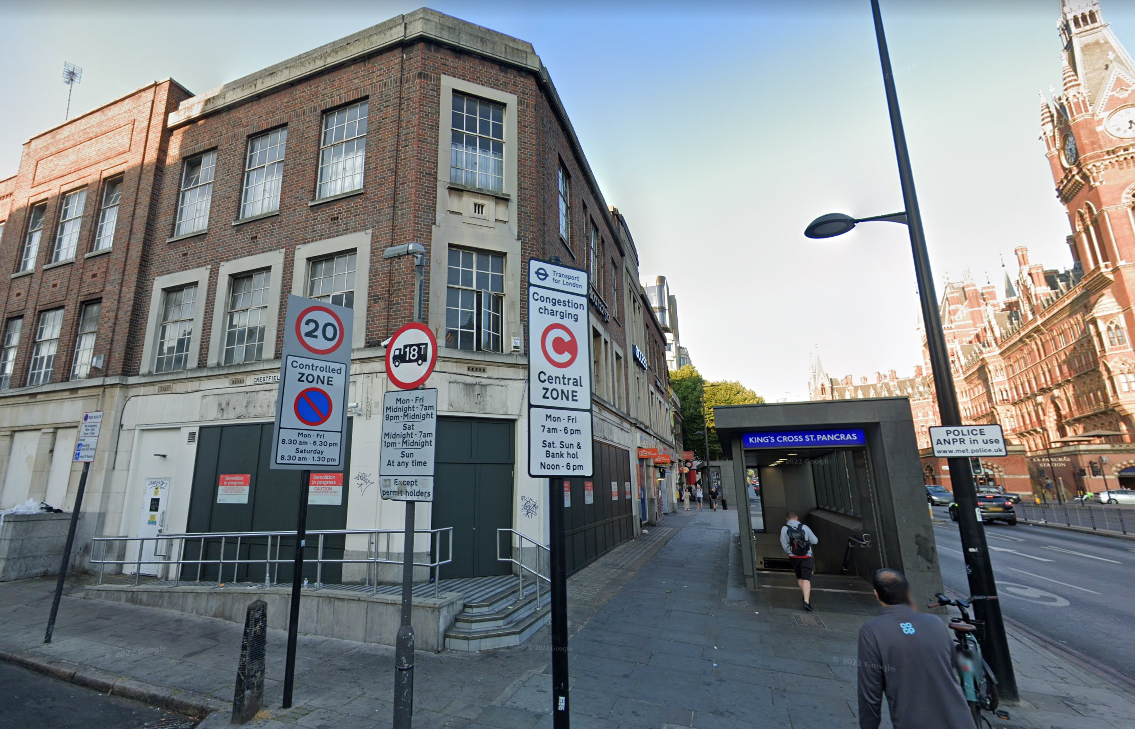
Earlier this week I was walking towards Kings Cross Station along Euston after attending a talk at the British Library. I was horrified to look across the road and see that Belgrove House, until quite recently home to the Post Office, Access Storage and other companies, is currently wrapped in plastic with signs all around the whole block to Argyle Square telling us that demolition is in progress.  

These pics of the building, taken as screen shots from Google Streetview dated July 2022, show that demolition signs have been on the building since well before that date and, had I reinstated my 'All change here! guided walk about 1930s KX architecture this year I would have already noticed being as this building obviously features as a stop on the tour. 

Hey, it may not as impressive as it's counterpart in Victoria, but it's a well-constructed yet understated neo-Georgian style that sports many key 'Art Deco' motifs including Jazz Age metal grilles and elegant brickwork. 

Also, it's an important link to the past. But having already posted about this potential loss on my Facebook page, and gleaned responses, it appears that Camden Council have been negligent as regards their assessment of the site and the age of the building. It’s hard to believe, seeing as this sits a few doors down from Camden Town Hall, but they think the original coach station was demolished and replaced with this structure. Yet this is the bus station, not a replacement.  To my mind it’s the brick finish that confuses people. If interwar buildings aren’t rendered and painted white then people don’t recognise them.  Also worth mentioning that Victoria Coach Station didn’t look as bright when it was first built. Go google.  

Lazy idiots. Especially because photographic evidence of the building in the 1930s does exist and more info is available here, thanks to Save Bloomsbury, which also highlights that the building has been under threat since at least 2020. I am rather frustrated that I have only discovered all this now as having walked past the front of the building many times these past few years I hadn't noticed anything on the building declaring the plans. See here for December 2021 where, despite objections already being raised, there are no signs of change. wouldn't have seen this having researched the building in 2019 and not being able to lead walking tours during Lockdown. 

So, what's replacing it? Brace yourself... see last pic, below, for an artist's impression – there's plenty more across the web here.  

I'm thinking a 90 year lease was due to expire? The coach station building has been there for over eight decades and the external structure has always looked, to me, to be in very good condition. And I always admired how it had been sympathetically designed to fit in with the Georgian buildings that would have then stood at either side. I am not sure we can say the same of the high-rise proposal that will replace it which I very much doubt will be standing there for a similar time period. 

Oh and one more thing, M@ the Londonist guru points out that Oasis filmed Supersonic on the roof of the coach station – it has some great views of the surrounding area inc KX station. See here. 


This last pic sourced from here – akt-uk are the structural engineers working on the new build.

19 September 2021

A cotton-picking conundrum in Goswell Road

There is a lovely temple-esque tiled façade on a building at 338-346 Goswell Road, a stone's throw from the Angel junction in Islington. On it are four roundels depicting, from left to right, a worker in a cotton field, a sailing ship, a steam ship and a steam train.

These two pics show the building in 2015 when the metal panels between the windows were painted white


In 2015 the paint on the window panels was removed to appear as a bronze colour, taking them back to how I suspect they would have appeared when the building was first constructed. Then, in 2019, a lick of black paint was applied.

In the last few years there has been serious debate concerning the depictions of historic figures associated with the slave trade. This has lead to the subsequent removal of statues and memorials across the country. Here in Islington, questions were also raised about this Goswell Road building and whether the roundel showing a black worker in a cotton field was suitable in today's climate.

In November 2020 scaffolding was erected and, during another renovation process, the roundel depicting the cotton fields was over-painted as solid blue. However, if you look closely, indeed from the other side of the road, you can easily still make out the raised lines.

Whilst I do understand the important decisions we should make as to who is commemorated on our streets, nobody has as yet come up with a decent explanation as to why this cotton-picking roundel was put here in the first instance; who or what does it accurately relates to? And I think that's important. If mistakes have been made then we should learn from them. I, for one, would like to see a small plaque at street level, explaining why the blue paint is there so that people can learn about the past and how we should improve ourselves going forward. 

So who built 338-346 Goswell Road? And for whom? Where were the cotton fields? Over the past six years or so I've occasionally tried to look into this and I have a few ideas (see below). Back in 2016, an enquiry on the subject was made to Islington Archaeology and History Society and Michael Reading gave this explanation which seems to have become the cut-and-paste explanation for everywhere else I've seen it referenced:

[edited] These used to be five separate properties ... a variety of business and trades, except for no 346 which was occupied for the whole period as the Brethren Meeting House. From around 1930 to 1933, there were no entries ... The 1933 directory shows that nos 338-346 were occupied by the International Tobacco Company Ltd and Peter Jackson (Tobacco Manufacturers) Ltd. The 1935 directory has the same entry, but 1939 shows that these premises were now occupied by Post Office Stores Dept (Goswell Road Dept)... I would venture the black worker signifies tobacco farming. The two images of ships, one by sail and the other by steam, signify the export of tobacco around the world over many years and, finally, the image of a steam train the delivery of finished tobacco products. 

Having checked the available directories and maps myself, this all rings true as regards who was there at those dates. However, this often-repeated explanation of the roundels has always confounded me being as the depiction here is clearly of cotton fields rather than a tobacco plantation.

A few years ago I found something about this site being the premises of the Cooperative Wholesale Society but I cannot now find where I sourced that – I probably lost that reference in what I refer to as "The Great AppleMac Crash of 2018" when a large chunk of my un-archived research was deleted when the mother board died – grr!  But, if my memory serves me well and this is indeed a CWS construction, I'd suggest that this beautifully-designed façade is a product of the architects working under consistently-innovative Leonard Grey Ekins, head of the CWS's London-based architects, and the gap in the records could suggest that the building was constructed in the early 1930s, which visually looks to be about right. Then, when CWS vacated the site the tobacco company moved in for a while prior to the buildng becoming the Post Office Stores. 

This would explain the reference to cotton farming and the transport of that commodity because Robert Owen, the founder of the CWS, was a social reformer and philanthropist who had started as an importer of cotton. If Robert Owen is the key to the roundels, and I rather hope so, then I very much doubt that he was employing what we'd call 'slaves'. As an advocate of workers' rights and good working conditions, he would have more likely paid his workers a decent wage and offered on-site housing of some kind.

I had an idea that perhaps the building simply depicts some motifs relevant to the area's history. Indeed there is another link to cotton here – British History Online makes reference to John Hall, a City cotton merchant having factory premises adjacent to here in the late 18th century and this also ties in rather well with the images in the four roundels. John Hall is quite a common name, and I found this, which I think is probably the same man and makes for interesting reading. But, if that is indeed what's being shown here, it still doesn't explain who constructed the building and for whom, so I'm clinging on to my Robert Owen idea and I will update here if I find out more.

Oh, and another thing... I am wondering if these ceramic roundels were created by the wonderfully-gifted Gilbert Bayes as they really do look like his style. Which reminds me, I really must organise an online talk about him. To much to do, too little time... 

338-346 Goswell Road, September 2021

2 May 2017

Caledonian Road manholes and cover plates – Jeremy Corbyn eat your heart out!!

Jeremy's not the only pavement nerd in Islington.
You are probably already aware that I am partial to interesting boot scrapers, flame snuffers, fanlights and coal hole cover plates. Well just like my MP who likes to photograph man hole and storm drain covers I too often scan the pavements and tarmac for unusual functional metalwork.
It's not about crossing numbers off a list, as per a trainspotter (though Jezza might indeed have a shelf full of old ironmongers' catalogues), for me it's about the marriage of design and functionality, spotting a 'new' design I hadn't seen before; noticing new wordings and agreeable patterns.
Designs have changed or have been adapted over the decades. Some companies have become completely defunct as utilities change and thus become metal ghosts of the past.
The twelve photos below, all taken along Caledonian Road between Holloway and Caledonian Road tube station, perfectly illustrate my point.


Having noticed how the wording for specific utilities had altered over the years  I took lots of snaps on the walk back to illustrate this. It always amuses me how other people on the street look at me in a strange way when I do this, – they probably think I work for the council or something!
Notice how the first three for Electricity Dept are slightly different; some with full points/punctuation, some without, each varying typographically in weight and style:


I also spotted a couple with Electrical Supply on them and another with Electric Light. A real super-nerd in this field would be able to accurately date all of the above and put them into chronological order. I'm just happy to notice the differences.
Check out also the various cover plates for communications and water where similar changes have happened:


And finally, I spotted some real metal ghosts – access cover plates for London County Council Tramways:


Above are four of the tramway cover plates in this particular stretch of road.
In the 1920s the LCCT ran trams through Holloway to Caledonian Market and beyond. See here for some basic tram info. A short-lived compressed air tramway ran along this route from 1881-3.
If anyone has any further info please do let me know.

UPDATE (June 2017): Since writing the above, I have noticed tramway covers elsewhere, though they seem to be in batches and then stop for a while, as in the middle section of Caledonian Road and some stretches of Holloway Road and Upper Street.

9 February 2016

Holland House in The City

Continuing on from last Thursday's post...

Holland House, 1-4 Bury Street, London EC3A 5AT.
This was the first steel framed buildingto be constructed in in Europe and ooh... I love it...
One hundred years ago, who'd have known that the windows on this beautifully-designed office building would one day reflect one of The City's most iconic glass buildings...?
Holland House was built during WW1. It was designed by the Dutch architect H. P. Berlage for the Rotterdam-based William H Müller & Co; a shipping and ore-mining company working out of Spain and North Africa – this is is shown by the wonderful stylised granite sculpture by J Mendes Da Costa of a ship powering through the waves on the rear corner of the building opposite Cunard Place.
These four pics show details of the lobby/reception area at the front of the building designed in the Art Deco style by Bart Van Der Leck featuring fabulous tiles, mosaics, metalwork and lighting.
Apart from a lovely art deco staircase leading down to the basement, the entrance at the rear has not retained the original features, and looks really bland in comparison.
The whole building is clad in hand-made dark eau-de-nil coloured tiles. I love the way the windows are obliterated when one walks along the pavement; only the columns of tiles can be seen, making a wonderful geometric pattern. 
Pic2 shows a glimpse of the mahogany panelled offices on the first floor using wood reclaimed/stripped from Muller's ships.
At the rear (pic3) there are some lovely balconied tiers.


See also Summit House on Red Lion Square – built a few years later in a similar style – solid, beautiful functionality and classic no-messing design.

6 October 2015

The Bridges of Waterloo Station

Here are some lovely colourful images of the railway bridges and viaducts at the front and side of Waterloo Station.

© Jane Amelia Parker, 13th May 2015

14 April 2015

You can wash your hands

I live near the Emirates Stadium, home to Arsenal football club.
It means nothing to me except that I sometimes have to change my journey if I need to use the public transport on a match day due to the restrictive in/out at the tube station when a game starts and finishes or the slow traffic on the roads. Oh, and some of the supporters invade my local pub. But at least they have good taste.
One good thing about the stadium is the facilitates an easy cut through when walking from Holloway to Blackstock Road via Drayton Park and Gillespie Road. and it's rather nice wandering around the stadium when there is no one else there.


When I was doing just that recently I noticed how a glimpse of old houses in Drayton Park formed part of a mini quilt pattern in amongst the contemporary architecture so I took a photo. Turning into Gillespie Road the tube station was like a jewel against the bright blue winter sky.
Back in August 2009 I took a wander around the stadium. Below are some of the shots from that day.


I have only ever been inside the stadium once, and that was for a Bruce Springsteen gig. Dave, my then boyfriend was, and still is, a big fan of The Boss and had bought us overpriced tickets to see him at the Emirates. Stadiums are so not my choice of venue for live music and he knew that. So I have no idea why he bought me a ticket to see someone I vaguely like at a huge impersonal venue, bet, hey, that's another story.
So there I stood with Dave and his friends in the middle of the plastic covered pitch, craning to see something. The sound was dreadful; muffled. The view was hindered because I couldn't see over the heads in front of me and the live film feed was being shown on the screens that sat on the stage rather than the ones up high (eh?!) and Bruce and co were wearing black against a black backdrop. Add to that the beer choice was piss lager or crap lager.
So I left about half way through and walked 5 minutes to the pub where I could hear it clearer and sup on a pint of something no-gassy.
As I was making my exit the security man on the door asked why I was leaving. I said because of the poor saound. he said many people had complained the night before. Oh gawd.

30 September 2014

Walking through the Rotherhithe Tunnel

Jen had been on about doing this for months. We finally agreed a date and met at Rotherhithe station on Sunday 14th September – a Sunday being chosen because the tunnel would be less trafficated*
There is pedestrian access to the tunnel opposite the station. We walked down the stairs (there is a similar set of stairs further down the soft slope on the opposite side and a similar arrangement at the north side) but then we turned right/south so that we could walk the full length, stopping to admire St Olav's Norwegian church with it's lovely long boat weather vane and the BRUNEL artwork near the mouth of the tunnel by Kevin Boys and Steve Cornish.

And so we set off for our march through the tunnel. I walked on the east side and Jen and Malcolm were on the west side. J+M got to briefly examine the old ornate Victorian access stairs that come up next to the Brunel Museum on the south bank and within King Edward Memorial Park on the north. These now house the extractors and there are signs saying not to loiter due to the fumes. Ugh.
On my side I had the green signs indicating how far there was to go in either direction and I also spotted that there were evenly-spaced rectangular metal handles about six inches wide all the way along at shoulder height. I am guessing that perhaps these were used to tie frightened horses to, or something similar. Answers please.
"Beer" said Malcolm as we exited. Being a Sunday we had to wander the Limehouse streets for a while until the pubs opened at noon. I took them over to York Square Gardens and we investigated a gorgeous little row of Georgian house in Flamborough Walk where front gardens must have been truncated when the railways arrived.

Hurrah. Noon! Beer o'clock!  I'd spotted the The Old Ship on the corner of York Square Gardens when I was in the vicinity a month before – it's got a Mercer's maiden on it.
Lovely pub, lovely people. Good cheap ale and proper hand-made fresh sandwiches. They do cabaret nights, open mic nights, there's a beer garden (not needed really when it's a corner pub with street seating), and the place is festooned with amusing and interesting knick-knacks. I can't recommended this place highly enough. I'd be more than happy to have it my local.

Read Malcolm's account here and be sure to scroll down and see me imitating a breakdown.


*a word another friend invented which I think should be in common use

22 October 2013

World Hunger and St Pancras International Station

I popped into St Pancras Station on Sunday 13th because I had heard that an orchestra would be there who make music using the unused parts of vegetables as part of World Food Day (16th October). Watch this video which explains this cause far better than I can attempt to do so here. It includes footage taken at the station.
Whilst there I also picked up some information from Action Against Hunger. It's appalling to think I am living in a country that throws away a lot of unused  food, yet there are people in the world who are barely surviving. A lot of these people are living in countries who grow and export foodstuffs to countries such as the UK. Need I say more?
Whilst the first floor of St Pancras is a buzzing with people milling about going here and there, drinking, eating, shopping or just waiting for trains, the upper level is rather quiet. And it's a shame. The "longest champagne bar in Europe" had only two tables full that Sunday afternoon, and I was the only person admiring Martin Jennings' affectionate statue of Sir John Betjeman. Though there were a few people looking at that hideous oversized statue of the kissing couple. I popped in to the Things British shop to check on my product display. Tom has written about the shop on his very inforamative site here.
Seems to me that the lack of people on the first floor is down to access from the Euston Road and KX. Many people new to St Pancras Station do not appreciate that it's actually quicker and much nicer to go up the short flight of steps at the front right which takes you to the original entrance close to the old ticket hall which is now part of the gorgeous hotel (see my pics of the interior below). From the first floor you get the best views of the whole station and it's wonderful unsupported roof before taking the stairs or escalator down to the platforms.
Contrast this with the maze as you enter from street level and then collide with tube travellers and get coralled into a shopping mall. Ugh!

7 May 2012

I am on the London Grill

This went live on the 4th, so you may have seen it already... my replies to David Styles's questions on the Radio Taxis blog.
Ten "devilshly probing questions about London" and they don't take "Sorry Guv" for an answer.
I am in esteemed company... check out some of the other people who have been quizzed.
See my answers here.
David mentioned me in an interview he did for Londonist.

4 May 2012

A lovely day Greenwich

On Monday morning I went to Greenwich to display some of my clay pipe jewellery in Bullfrogs shop window in Church Street.
A friend came to meet me there and we went for lunch in a nearby restaurant where I bumped into another friend's daughter who, unbeknownst to me, is studying at Greenwich Univerisity. Lucky girl to be in such a great location, and what a nice surprise to see her, as I don't think I'd set eyes on her since she was about 15.
It was a glorious day so after lunch I went for a wander...
In the park I admired the construction of a labyrinth of metal poles that will become the controversial Olympic equestrian venue. Outside the Royal Maritime Museum I spotted the oversized ship in a bottle that was previously on the 4th plinth in Trafalgar Square. I went inside the museum and was a bit disappointed. I was engrossed in the gallery with the pics of the then and now stretches of Wapping and Bermondsey, but leaving that room I couldn't find anything else to inspire me. Did I miss a trick somewhere? If so, the signage is appalling. And I had hoped there would be more and larger maps and charts for sale in the shop... but I digress; this is supposed to be about nice things...
A raspberry ripple ice cream and then to The Painted Hall, 'the finest dining hall in Europe', no less. I had been there before for a Christmas do a few years back (actually, it was the company my lunch friend works for) but, although we all had that 'wow' moment when we entered the room, we then became preoccupied with all the food and drink. But mainly the drink. The hall is like an OTT set for a bizarre film; you feel as if you are actually in a painting. Every inch is covered with fantastic images and trompe l'oiel.
Then I popped into the beautiful Old Royal Naval College Chapel and admired its repetitive yet soothing interior. There was just time to pop into the ORNC museum. I just love the big relief map in the centre of the main room. In fact the whole of that room is jam-packed with so many interesting and interactive and informative things. It was closing in ten minutes; that's the third time that's happened to me!
So to the Cutty Sark. I like what they've done. I like the way the glass surround evokes the sea. I like the reflections it creates. It was closed so I couldn't go inside but I notice that the roof of the shop area is practically the same as the new roof at the Kings Cross Station, which is almost the same as The Great Court at the British Museum. couldn't they have designed something different?
I admired the view across to The Isle of Dogs and thought about walking through the foot tunnel. I noticed that the tide was low and I could see shingle on the other side beckoning me, but I had the wrong shoes on. So I got on the DLR and headed home instead.
What a nice day.

7 January 2012

One Eye Grey now on Kindle

The erudite, informative and entertaining Mr Chris Roberts has just informed me that his collection of strange London tales, collectively known as One Eye Grey and previously available in pamphlet form, is now available on Kindle.
I urge you Kindlers to get clicking and downloading.
Enough said, because I have written about these tales before.
The eyes have it:
Top: Battersea, Islington, Marble Arch, SE1
Middle: Acton, Haggerston, Battersea, Holloway
Bottom: Hoplloway, Harlesden, Islington, Spitalfields

12 September 2011

The London Transport Museum

I finally managed to get to the London Transport Museum last month.
For years I have had it on my list of places to visit*. How on earth I have left it as long as this is beyond me.
Last year someone contacted me through this site and sent me a complimentary 'admits two' ticket. I now cannot recall who that was, so if it was you, please do get in touch.
I stuck the ticket on the pinboard and kept saying I would "go next week". I recently noticed the expiry date on the ticket read '31st August 2011' ... there's nothing like deadline to make me get my arse into gear!
So I called Mr Edwards and, knowing he likes shiny things and transport, asked him to be my plus one.
All I can say is we should have gone in earlier because we ran out of time. There is so much to see... old tube trains, buses, trams to compare with a prototype of the new Routemaster (not really sure what I think of that until I see it in action), plus lots of info everywhere including a looking-to-the-future section where there are some truly bizarre ideas. I loved all the posters and leaflets and timetables especially from the first half of last century and could have spent a day alone just looking at those.
And it's a really great museum for children. Many of them had cards that they could 'punch' in the special machines dotted around the museum. My inner child was envious that I didn't have one of my own, so when I found one on the floor my afternoon was complete.
Thanks to Malcolm for the photos.
*The Imperial War Museum is still on that list, as is Dulwich Picture Gallery and Chiswick House and they are just the first 3 that pop into my head... oh dear, what a terrible admission!

31 July 2011

Walk The Lines by Mark Mason

There are lots of book about London. You'd think there couldn't be any more to write but every now and then someone comes up with a new idea; a new take on things...
Mark Mason has walked the entire London Underground overground, by which I mean he has followed the tube lines at street level. His book 'Walk The Lines' tells the stories of his journeys, covering hundreds of miles. It's a great read... full of wonderful London facts, amusing trivia and meetings some odd and interesting people. I like it a lot. Here's M@'s review.
I am now singing that Wombles' song, which reminds me of Steven Smith's wonderful Underground London. I keep saying I won't buy any more books and will instead just borrow from friends or the library, but every now and then another one comes along that I just have to have. I need to put up some more shelves. These are nice.
Top: Mason in Battersea, Victoria in Victoria, Baker[loo] in Tottenham, Central in Holloway
Middle: Hammersmith in Holloway, District at Gloucester Rd, Northern in Hornsey, Circle in Bloomsbury
Bottom: Piccadilly in Piccadilly (but no more; RIP), Waterloo in Waterloo, Jubilee at Hungerford Bridge, Metropolitan at Farringdon.

20 July 2011

The Victoria Line

I recently learned that the Victoria Line's upgrade is now complete and every train on the line is 'new'! According to TFL's blurb, these new trains are "more spacious and have wider aisles, as well as improved customer information, CCTV and better ventilation". Well well.
So what have they done with the old stock? Will we be seeing the carriages looming over Shoreditch as pop-up offices? Or perhaps they can be given to youth groups to practice their tagging skills on?
But don't get too excited just yet... all is not finished, for there will be planned closures on the line for sometime yet, and on most of the other tube lines too... But at least we can rest assured, knowing that when the Olympics begin the whole tube network will be running as smooth as clockwork* ;-)

16 Victoria Line stations:
*a wind-up clock

3 June 2011

Electric cars – are they our friends?

See what I did there? Two Gary Numan songs for the price of one.
But to the point... what's all this nonsense about electric cars needing a noise? Are we all expected to go blind some time soon?
Do humans have motion noises? Ditto dogs and cats? Do pushbikes make any sounds? Well, yes, riders are supposed to have and use a bell, but they don't.
We have eyes at the front of our heads with which to see if there is traffic coming – has no one learned how to use or cross a road?
So who are we/they 'protecting' this time?
Oh yes, those jaywalking numpties who are far too busy twittering and listening to their iPods to be arsed to learn the difference between road and pavement.
Whatever noise is chosen it's going to be awful... nee-nah nee-nah, ding-a-ling, whoosh, parp parp, vehicle reversing, vehicle reversing... ker-thump!
And where do people think all this electricity is going to come from? Will it be magic'd out of thin air? A lot of energy goes into making energy, you know.
Top: Bermondsey, Bloomsbury, Lambeth, Brompton
Middle: Southwark, Hoxton, Dalston, Bloomsbury (RIP)
Bottom: Lambeth, Battersea, Hackney, Vauxhall