Showing posts with label Haywards. Show all posts

12 June 2023

A large Hayward Brothers coal hole cover – size really does matter

There are lots of coal hole cover plates embedded into the streets of Marylebone. A large percentage show they were manufactured by Hayward Brothers of Union Street, Southwark. At the eastern end of Devonshire Street, outside what is now the Turkish Embassy at 69 Portland Place, there is this coal hole cover plate, also made by Hayward Bros:

But look closely near the centre and see that it a 21" coal plate. I can't say that I have ever seen one of these larger formats anywhere else. To put this into context, here it is in vague proportion with a collection of other Hayward Bros cover plates in the immediate vicinity, all of which have standard 12" plates, some of them set some within a ring/rim. 

And to further illustrate the size difference, here re shots that include my lovely trainers.

Cool huh – both the large cover plate and my Nike Internationalists!   

Question is, why was this building created with just one very large access/storage point for coal rather than a long bunker under the pavement with multiple standard size plates as I have seen outside many other large properties? I suspect it was a constructed as large family home, but I don't have access to the any info as to who lived there originally. Any additional info welcome. 

For more of my posts about coal hole covers, simply click here. 

26 October 2022

How to lift a coal hole cover plate – a dilemma

I have often pulled together collections of coal hole cover plates showing how diverse the range of designs can be. Most of them sport a pattern on them to make them anti-slip and often used as a means of promotion for the hardware store or iron founder. They show no visible signs of how the covers/lids might be lifted and evidence about this process, or diagrams to explain the construction, has proved elusive or inconclusive*. 

Whilst presenting a talk about coal holes at London Historians History in the Pub evening last month I asked the audience for ideas about their usage and the consensus was that the scullery maid would have pushed up the cover plate from the coal bunker below so that the delivery man could then remove the lid by hand. He would them drop it back into place after delivering the order. Being flush to the pavement, with no protruding lips to get a grip on, meant the lid was unlikely to be tampered with, or stolen/removed, and the coal below was as good as inaccessible via a short narrow access pipe barely big enough to squeeze your head through.

Some plates were 'self-locking' as shown here. If you look closely you'll see that there are little notches/gaps in the design within the outer circles and it has been suggested that perhaps these needed to be aligned to make the mechanism work. I think this is very dubious idea being as in this example we can see there there are four gaps at 90 degrees other on the cover plate, yet there are six at 60 degrees on the rung. And how would you rotate it?! 

The explanation is that a catch was released from below ground and this enabled the cover plate to pop up proud of the pavement, making it easy for the coal to be dropped down into the hole. The plate was then dropped back into the outer casing and pressed flat to the pavement, causing locking mechanism to click back into position. However, these self-locking plates must have proved unsuccessful seeing as additional locking mechanisms were later added as per here.  

*Hayward's of Union Street, Southwark, were the B&Q of their day and as such would most certainly have produced an extensive catalogue ... do you have any reference of these?

All suggestions and further info is most welcome. Please use the comments section below or email me at jane@janeslondon.com 

19 September 2022

More coal hole cover plates – this time in Marylebone

Last week I was looking up at demons and here I am looking down again, but it's far from gloomy... 

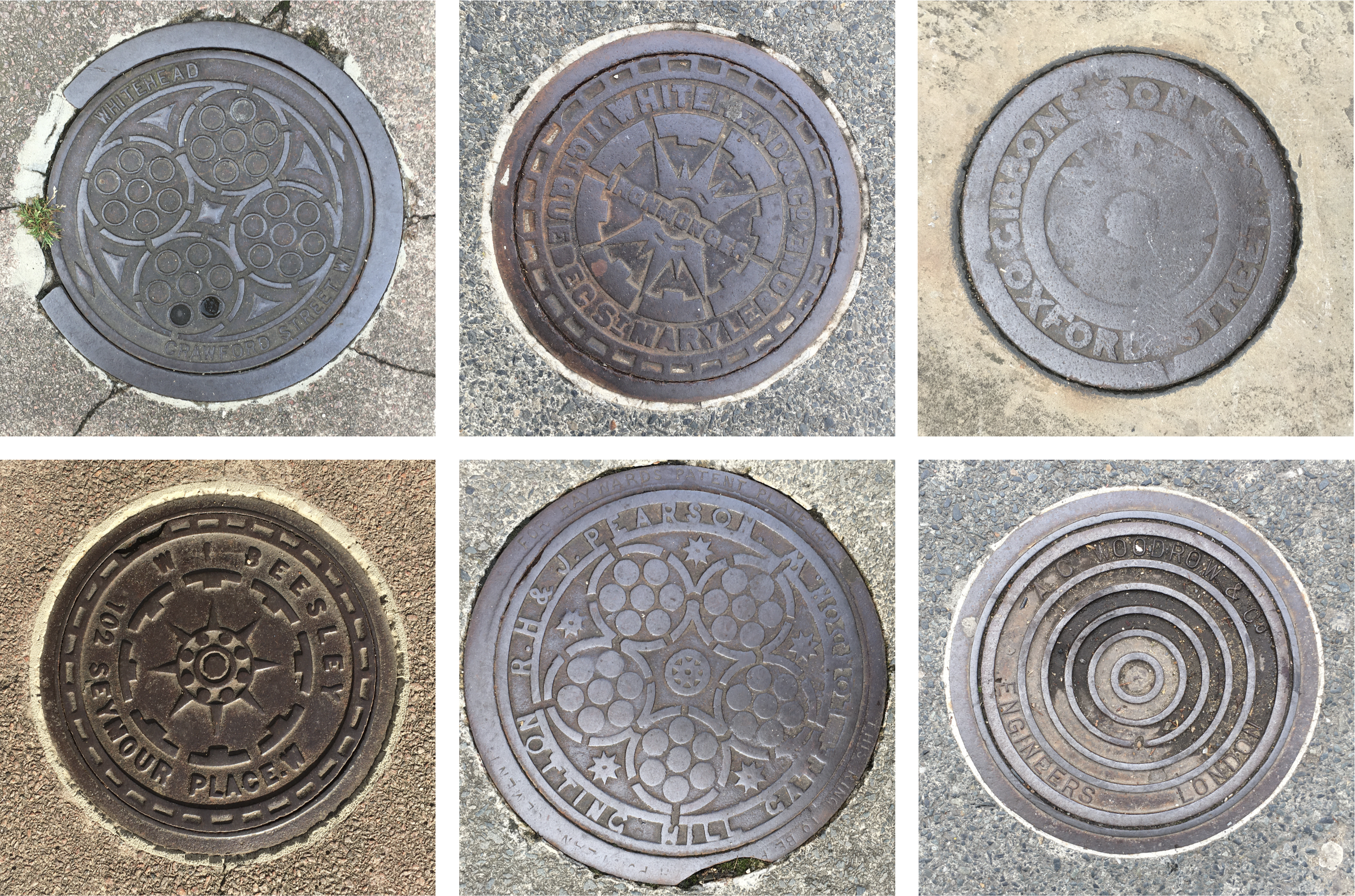
I was recently on a mission to check up on some 'Art Deco' buildings in the area between Marylebone Station and Baker Street when I happened to spot a few coal hole cover plates with names on that I was sure I hadn't seen before. The one that first caught my eye was in Balcombe Street almost at the junction Ivor Place and it bore the name 'Whitehead'. I took a snapped a quick pic and was about to continue my journey when I noticed another plate a few metres away with the same name but a sporting different design (see below, top left and middle). Hmmm... I scanned some adjacent plates and noticed the diversity of names, a couple of which I was convinced weren't in my mental database. 

Oh gawd. What to do? Continue with PlanA or let myself get distracted by this new project? Of course, I went for the latter. 

From the Ivor Street junction, I walked northwards keeping to the left/west side of Balcombe Street, then at the top I crossed over to the other side and went back down to where it the street meets Dorset Square. I then did a circuit of the square and went back up the left side of Balcombe Street to complete the full loop, ending back at the Whitehead plates.

I have endeavoured to show the plates in roughly proportion to each other here. Most residential plates are the smaller 12" ones (excluding the outer ring), though I did snap a couple of the larger 15" ones which are more usually seen outside larger establishments such as pubs or restaurants and this hints to me that some of these houses here, being a stone's throw from Marylebone Station, were hotels. Indeed, I didn't check to see if they might still be. 

A few of the plates here have holes within the designs to allow ventilation within the coal cellar below. These are evidently part of their manufacture, but I have seen many examples elsewhere where holes have been retrospectively drilled in a random fashion by people who clearly have no regard for the design!  The three different Matts plates (below) show how that company's name and address has evolved in many ways.

Notice how in some cases the patterns on the covers are the almost identical. This is simply because the ironmonger's name has been added to a pre-made mould that was already available at the foundry. However, some of the more successful and wealthy ironmongers had their own bespoke, and therefore identifiable, designs created, as per the Gibbons plate at the very top and, although the initial process would have been expensive, repeat orders from that mould would be the same price as the off-the-shelf ones.

Unusually, compared to other streets of this era, there is no clear single winner amongst the range of local ironmongers shown. Elsewhere, it's evident that one local business has been engaged to supply the plates for a whole terrace having been contracted by the developer or contractor when the houses were first built. Instead, in this part of Marylebone, there is a mix of all sorts – some show local businesses in Marylebone, Edgware Rd and Lisson Grove, but others come from further afield, but only a few miles, as can be seen by the streets and locations on them. There are, of course, quite a few sporting the name Haywards of Southwark, the company being the B&Q of their day. And, without going back to count them, I'd guess either Sampson of Euston Road or Matts of Paddington were the two most common local names in this vicinity, with Stone coming in 4th. 

Something else I found in Balcombe Street that I don't think I have seen before... some HUGE slabs of York stone paving which I estimate are almost the size of a double bed.  

At the top end of the street, north of Ivor Place, on both sides of the road, some unusually large pieces of natural stone sit above the coal cellars as street paving. These super-size slabs must have been really expensive and I wonder how they were transported and how difficult it was to install them. There are coal holes within every one of them although some of the lids have been removed or infilled. I am intrigued by the ones that have been filled/replaced with strange bits of flint that looks like left-overs from church walling – something else I have never seen the like of before. 

Looking down can be so fascinating... later that day, I as good as stumbled upon a 21" Haywards cover plate about half a mile away from Balcombe Street, by which time I had run out of phone battery and it was getting dark. I will return to it soon and put together another collection.

Lots more coal holes here.

27 September 2019

Unusual light wells and coal holes

Earlier this year I stopped in my tracks outside 258 Pentonville Rd, when I happened upon a very unusual light well running the full width of the shop.
I say 'unusual' because it's got coal hole cover plates embedded within it (one at each end) and this was the first of this kind I have ever seen.

Ironwork and glass made by The British Luxfer Prisms company
Further sleuthing on Google Streetview shows the reason I hadn't ever noticed it before – it's been covered up for at least ten years, and this also explains its rusty condition.
And then last month I found another one in Birchin Lane a narrow street that joins Cornhill to Lombard Street in The Square Mile. Half way along, near Cowper Court, I happened upon a simpler [later?] combo with glass bricks embedded into concrete.

Made by Haywards Ltd
And then, can you believe it, I found another one – this time just off Cloth Fair. And here's me thinking I am observant yet I have been marching past these for decades! This particular site has even has some light wells arranged as the steps into the building (I had already spotted that though!).

It's amazing how interesting and diverse these light wells can be. At the junction of Jewry Street/India Street in EC3 there some examples with lovely horse motifs on them which, again, is something I haven't seen elsewhere, though, judging by the cole-hole-light-well-combos I will probably be finding more soon.

Made by the St Pancras Ironworks Company

I am not the only nerd interested in this kind of thing. See Yelfy's Faded London for more.