Showing posts with label art nouveau. Show all posts

26 May 2025

A walk from Ealing Broadway to Acton Central

Last Tuesday I met my friend Sue for a wander in West London. We met outside Ealing Broadway station and, before we set off along the Uxbridge Rd towards central London, I wanted to show her a lovely shop I had discovered a while ago when I was out on one of my 'where does this bus go to' mystery routes. Just north of the station, facing Haven Green, passing a sign for squash courts that sits above an earlier hand-painted sign for squash courts, there is a beautiful old chemist's shop: 

36 The Broadway still bears the name of D. L. Lewis set in metal across the granite front and within a panel in the entrance way. There is also a more recent neon sign within the window.

The sinuous letterbox is also lovely, as are the flourishy figures used for the door numbers at either side of the entrance. It all screams fin-de-siecle Art Nouveau.

When I had been there last year, the shop had been closed and I could only peer in through the plate glass, but this time it was possible to go inside – and what a treat!


Much of the front part of the shop is original as regards the shelving, storage and display areas. The floor has been cleverly covered in a herringbone wood effect lino and this continues to the rear section where a faux panelled ceiling is also in place, no doubt evoking what used to be there in the 1900s. The shelves showcase many old bottles that once contained all sorts of poisons and potions no longer available to us, and I particularly like the huge blue and green droplet-shaped bottles.
We walked back past the station and found another shop of particular note – Paddy Power's betting shop at 7 The Mall is absolutely gorgeous and clearly dates from the same era as the chemist's shop:


It's sublime – the central threshold contains a terrazzo 5-pointed star motif flanked by carved and bent wood and curved glass, with a mirror'd ceiling in six sections that I have tried my best to photograph without being the star attraction myself. 

However, many of the other shops further along the terrace are empty and in a poor state of repair such as these four here and I am concerned about their future. Many of the coal hole cover plates along this stretch bear the name of White & Son of Oxford Street which dates them to the late 1880s – read more within here.

We crossed the road walked towards Ealing Common where, on the northern edge, there is a marker telling us we are 6 miles from London (Charing Cross) and 9 miles from Uxbridge.


I wrote about a similar metal mile marker here. This Ealing one dating from 1832 appears to have lost a motif in the top section.
We continued across the common, admired the handsome trees, had a half of ale in the garden of The Grange public house, investigated the exterior of the nearby church and pondered at the relevance of this gateway to Warwick Dene:

We wondered if Fraser's Patent Disinfecting Apparatus was something to do with farming and sheep dips. But I now think it's more likely linked to laundry, this being a hanging mechanism to suspend large items in a large vat underneath it. I've spent ten mins looking for decent info and I give up, though I have found this about a similar manufacturer.
The residential properties that abut the common on the south side, along and around Elm Avenue, remind me of similar estates in Gidea Park, indeed many of the street names are similar. Man hole cover plates in the roads show the name of pre-LCC 'Corporation of Ealing'.
 

At Ealing Common tube station we stopped to admire the gorgeous octagonal Art Deco interior (detail, above left) and, opposite the station, we found a green plaque for computer-whizz and poet's daughter Ada Lovelace, this being near to a house she lived in, since demolished. 
Approaching Acton Central's shopping zone Sue peeled off to catch the tube. I continued along to The Vale and then back again to see if much had changed since I last visited. The ghostsign for Dadd's boots store has gone, the space now cleverly filled in with a building of the same Victorian design. 
I then made my way to the overground line via Churchfield Road, a street that still retains hints of its middle class Victorian past including another large slab of York stone outside No 35 and the carved and gilded, yet faded, sign for C. Wright, ladies' and children's outfitter at No. 31:


Another nice day!

2 October 2023

George Carter & Sons of Maida Hill – glovers, hosiers and shirtmakers

A few months ago, within a post about bygone company names that display '& Sons' I included a business by the name of Carter, based in Old Kent Road, with many more shops across London.

Well, this afternoon I had one of those 'ping' moments when I recalled that earlier this year after a wander in the Kensal Green area, I was ambling eastwards along Harrow Road when I stumbled across a shop that still sports some of its original Victorian shop fittings including a beautiful threshold mosaic, here at number 371.

Not only does it have the marvellous mosaic, but it also retains the fine wooden spindle window frames above granite and metal on which the words GLOVERS, HOSIERS & SHIRTMAKERS are still perfectly visible. It's an absolute treat and an amazing example of the Art Nouveau shopping era that also included curved windows, polished brass and aproned staff.  

There is a mirrored wall to the left side as you enter from the street, designed to make the shop look bigger and bounce more light into the the shop (this being north-facing), and there are additional mirrors in the ceiling above this area. This next pair of pics shows the effect looking down and looking up: 


I have my fingers crossed that this old Carter & Sons shop is a listed/protected property. It's unusual, to say the least, especially with so many elements intact at one location. Retrospective Google streetview shows that it was hidden behind boards in the period 2008-2012 before it reappeared as we see it today. I am interested to find out from anyone who lives in the area if they have any info about the shop pre-2008.

I have found other similar examples across London, but mostly on shops that originally sold jewellery or funeral services. And not all of those shops have survived; sadly modernised with plate glass within UPVC frames. 

The description of 'Shirtmaker' can also be found on some outlets in the covered arcades either side of Piccadilly, as well as on the low curved corner of 67 Moorgate in the City of London, here. 

Carters biggest shop was at 211-217 Old Kent Road, but there's nothing left of it today, since demolished and rebuilt, today containing a British Heart Foundation charity shop at street level. 

But here's a nice pic of the shop when it was still trading that I found in a library book but forgot to make a note of the book title (whoops):


There are some great close-ups of some of the details on the building in Discover Unexpected London by Andrew Lawson, 1977:

Update June 2025: At the excellent Peter Mitchell exhibition at The Photographers' Gallery I found a photo he had taken of the shop in 1979. The caption was also written by him at that time:


8 February 2022

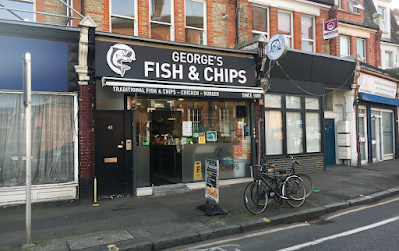
On the tiles at George's Fish & Chips shop, 45 Tottenham Lane, N8

At the northern end of Tottenham Lane, on the right and just before the fork where the road meets Church Lane and leads down to the right and Hornsey railway station, there is a fish and chips shop, opposite the old police station buildng. 

The shop doesn't look like much at first glance, being as the exterior is modern plate glass, having lost almost all of its Victorian metalwork and embellishment over the past few decades. You need only to look around at some of the nearby shops to be able to get an idea of how attractive this junction would have been 120 years ago. 

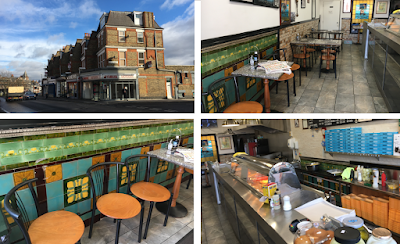
If you venture into George's you'll find some fabulous examples of fin-de-siecle tiles along the lower sections of the walls on both sides, specifically in the small seating area at the left and behind the counter too, albeit mostly obscured by cabinets. But hey, they are there and that's great.


These tiles really show off the colourful patterns of the Art Nouveau 1890s area. The grassy greens, deep golden yellows and peacock blues are absolutely gorgeous. There is also a stained glass panel at the rear which I assume is of the same era, but I doubt it would have been situated exactly in that position when the shop interior was first created. As regards the 'since 1890' claim, I am not sure what is intimated here. The 1901 directory shows this shop as No.9 Rathcoole Parade and the premises of James Brunton, fishmonger. Perhaps George is a descendant of James? Or they simply mean a chippy has been on this site since 1890.

I popped in to check up on the place earlier this month but, though the door was wide open and the place clearly open for business, there was no one about to talk to – I called out 'hello' but got no response and, in a rush to be elsewhere, I simply snapped these pics and sped off. Last time I popped in, ooh about 3 years ago, I'd had a nice chat a man who worked there. He was really proud of the tiles and loved that the history of the place is appreciated by many people who come into admire the original features (and eat the lovely chips!). I didn't ask if his name was George.

Nearby, there are other places that still hang on to their mad patchworks of Victorian glazed tiles. I mean 'mad' in a good way. Personally, I'd never consider putting some of these patterns together except in a catalogue. But the effect is dazzlingly good, such as a few doors along, at 59 Tottenham Lane, on the corner of Harvey Road where there are some lovely vertical panels of mixed tiles that are strangely at odds, yet enhanced and contrasted by, the faded ultramarine paint of Garden Transformations. The 1901 directory tells me this was Lucas & Co, house furnishers. You can also find lovely mixed tile collections surrounding the front doors of many residential properties in the area, as well as some excellent examples of old shop fronts in Hornsey High Street, but I will save those for a separate bulletin.

UPDATE 2023:

Although the premises is still trading in fish and chips, the lovely colourful Art Nouveau tiles by the seating area along the left side wall have been obliterated or removed. The guy I spoke to in there this time (not the same fella as before) said this had been done for Health and Safety reasons. Hmm. Really?!  I dispute that reason being as the tiles behind the counter in the food preparation area are still visible. Sigh.  

13 April 2017

Treasure House, 19–21 Hatton Garden

This is one of those 'how did I never see this before now?" moments...
Hatton Garden has for many centuries been London's "Jewellery Quarter" – the place to buy and/or trade in gold, silver, precious gems and diamonds.
In the early 1980s I used to work just around the corner within a grubby inner courtyard off Greville Street called Bleeding Heart Yard (before anyone knew where that was) and at lunchtime I'd find bargains in Leather Lane market (when there was a much greater variety of goods for sale) or I'd just go for a wander about and go back to work with something tasty from Grodzinki's Bakery.
So how come I had never noticed the panels above 19-21 Hatton Garden until last month?! Jeez! I even used to drink often in the Mitre which is accessed through an alley a few doors along from this building!


Treasure House (1906) has Art Nouveau styling on the doors with panels above depicting the story of gold from its ore to being a wearable item, though they don't appear to be in a chronological order and all the figures are muscular and godlike and hence shown naked whether mining or just admiring their own reflection. Perhaps having spent all the money on gold they can't afford clothes?!
I have tried looking for the name of the company who was originally here but so far not found anything, though I did find some info Ornamental Passions here. If you do know more, please do let me know

3 November 2016

The London Apprentice / 333 Mother Bar, Old Street, Hoxton

I was just having a tidy up and found this pic I snapped a few months ago of the original tiled entrance of this Hoxton venue.


The sinuous organic feel of the letterform dates it to the Art Nouveau era (approx 1890-1910). A bit of sleuthing confirms that the building was completed in 1895, however, I am finding it hard to marry up any of the external architectural features within these images – perhaps at some point it was rebuilt and only the floor was retained...?!  Doubt it.

Lots more wordy doorway mosaics here. Or just click on the relevant tags below or to the left