30 July 2021

Clogs, brushes and cycle accessories – two ghostsigns clinging on to what's left of Holywell Lane, Shoreditch, EC2

So much is changing around Shoreditch these days. Low rise Georgian, Victorian and early C20th buildings are fast being demolished to be replaced with high rise glass blocks. I went to check on what's happening at the top end of Norton Folgate, a part of Bishopsgate that I'd understood had been saved from development. It used to be an interesting architectural patchwork as you can see here.

As my pic here shows, part of this terrace that abuts Folgate Street has [sort of] been saved but only those properties with red brick façades remain (some are covered in netting); the rest of these structures will be completely rebuilt albeit not as tall as the blocks that are going up to the left hand side which forms the beginning of Shoreditch High Street where once stood one of my favourite interwar buildings, a castellated showroom façade covered in beige faience tiles; Niclar House*.

Rather jaded by this, I went for a wander around the nearby streets to see what else has changed during this past year, specifically interested to see if two old hand-painted advertisements were still in situ in Holywell Lane. I'm glad to report that they are indeed still there but clinging on for dear life, so to speak.

The two signs face each other across the now defunct Victorian railway line that has been replaced by the new section of rails for the Overground Line further along the street. It's really weird how these old buildings are somehow still hanging on in there surrounded by an undulating sea of tall glass.

The east-facing advertistement on the bottom right (above) is barely legible, and would need access to that upper level where the train carriages are to get a better view of the wording in the whole sign. Tetramesh has a better shot of it here. I originally thought I could see "MEX" in there at the middle right and wondered if this was a link to rubber from the Yucatan Peninsula in Mexico. Indeed, Milton Manufacturing Co cycle accessories was at this end of the street in 1915. Or it might be a ref to The East London Rubber Company or Rotax Motor Accessories who were both nearby in 1939.
But I have since had another, better, idea which also links to two-wheeled vehicles – I now think it's 'MAX' as in Max Steiner cycle accessories who were located at 35 Curtain Road, on the other side of the Gt Eastern St junction, for at least the period 1915-1939. More info on Max Steiner and the Pelissier brand here which includes some press ads. More can be found within Grace's Guide. I am pretty sure that, armed with the info in these ads, some of the wording on this wall sign can be deciphered. 

The sign on the side of No.55 is much clearer. It reads 'MAKERS OF. CLOGS. DRAIN & SWEEPS. MACHINES.' – this photo shows it more clearly in the 1980s. Having assessed the late Victorian directories, I think this is a sign for two or more products or companies available in this street.

At the very top front centre of No.55 there is a clear date mark: GT 1893. This surely must be George Tyrie, brushmaker. He could well have made the railsweeps; brushes that were often fitted to the protuding section at the front of steam trains to sweep away the leaves and other debris. Or it could refer to brushes and brooms used by railway workers who cleaned the rails manually. A dirty job.

And this links in with another company in the street, because at the same time, in the late 1890s, on the other side of the road at No.12, George Stevens is listed as a washing clog maker. It's possible that he was related to, the son of, Thomas Stevens who was listed at No.39 in 1832 (this might be the same property and the road might have been re-numbered, but I haven't checked). Thomas was one of two French clog makers in this street, the other being George Martin at No.44, before the railway line and before the building on which the sign was painted when clogs had evidently evolved to become boots. These heavy duty items of footwear had canvas leg coverings, sometimes up to thigh height, tightened and kept in place by leather straps and buckles. They protected clothes and the wearer from splashes, see right (a page in a Gamages catalogue). 

Ideas and info welcome – please use the comments section or contact me via social media @janeslondon

*Find out more – Niclar House features on London's Lamented Art Deco, my online talk via Zoom about some demolished interwar buildings and the structures that have replaced them. Click here for info. It used to form part of my Art Deco Spitalfields guided walk. Sigh.

23 July 2021

Remembering Fitzroy Square in the late 1980s

On Wednesday last, after leading a lovely group of London Historians on a meandering route through Fitzrovia looking at 1920s-30s buildings (people call the era Art Deco but it mostly isn't!), I decided after a much-need drink in The Wheatsheaf, Rathbone St, to wander back up to Fitzroy Square and have a look at something other than interwar buildings. Specifically, I was intrigued to see how this area has evolved since I worked at 4-5 Fitzroy Square in 1988-90.

For just short of two years I was studio manager and typographer for Art Integrators, a small artwork company situated in the rear lower level of this building which comprised two co-joined Georgian houses, the main reception being in the hallway of No.4 (the red door) which since 2012 is called Willan House, home to The British Association of Dermatologists. 

Art Integrators was a part of a larger company called Gannaways. We had external clients such as Cato Johnson, who I used to visit for briefs at Greater London House AKA The Carreras 'Black Cat' Factory a building and company that today features on my Art Deco Camden guided walk and within my online presentations or in-person talks. 

AI also did a lot of work for the other companies within the Fitzroy Square building, all being under the Gannaways umbrella. John Gannaway, founder and director (see more about John in the comments below), took a great pride in the building and I remember the colourful metal banisters in the stairwell, the handrails and the paint colours on the walls, all of which John had researched to be authentic. At the time I had thought that the pinks, purples, blues and greens were a bit strange, but you need only to visit Smithfield market to see a similar palette.  

Looking at the building last week I noticed for the first time that there are three animal skulls within the frieze at high level. I have no idea what they refer to. I had also never before noticed the fine fancy fanlight above the front door, although I do remember the front door being painted mid-grey in the Gannaways era. Also, I'm now noticing that gorgeous lamp holder and the railings. I have no recollection the great view of the BT/PO Tower as you exit the building. I obviously had other things on my mind back then!

Intrigued at whether anything could be seen inside, I peered in through the window at the side of the front door to see that the hallway is the same as I remember as regards layout and fittings but today the colours are muted and bland, tame pale greys and magnolia. There's no way the Georgians, the Victorians, indeed the early C20th century bright young things would have lived in anywhere as dull. Poor John and all his hard work. I peered down into the front basement area and remembered the two other Johns and Frank who used to work out of the below-ground office, yet I am not aware of them using the external steps. Instead, they would access through Art Integrators, going past my desk, back and forth to Solar Typesetting which was situated at the very rear of the building abutting Grafton Mews (see below). 

I really liked the guys in Solar, in particular Mick and Ron the bosses who were always always immaculately well-dressed in that old-school 1960s way; shiny shoes, tie pins, clean hands and aftershave. They sometimes let me use the compositor machine to make my the headline lettering for jobs myself, the machine being a kind of enlarger that produced crisp-edged large format letters on photo-quality paper. Using turning handles to get the right size and focus on a single character you then hit the button to photograph it, then moved on to take a snap of the next letter. I was very much in my element there as, since starting in the industry back in 1980, it had often been said that I have a natural ability for letter-spacing; The Queen of Letraset – a skill I think is sadly lacking these days where you can often easily 'drive a bus' through the gap in 11 and then blame technology if anyone points it out.


I particularly recall how I liked working with affable and super-efficient, self-effacing Bob, one of the Solar typesetters, and how impressed and intrigued I was at how he/they could turn my mark-ups supplied to them as written instructions on A4 sheets into beautiful long silky sheets of words, often created overnight to be ready for me next morning – they typed up the whole thing up manually, looking at screens of coloured codes and symbols that to my mind looked nothing like my starting point or the marvellous end product. There certainly was no opportunity for amendments – once it had gone to the typesetter that was it – changes were costly. Unless, like me, you were adept with the PMT camera and could employ a bit of clever cut and shunt. Today, we can amend our copy as we go along and change words, styles and fonts in seconds, effectively acting as copywriter, designer, typographer, typesetter, artworker, even printer, all at once. Jacks of all trades. Often masters of none.

There was a wonderful exchange of ideas and skills between AI and Solar with many of our in-house  chats taking place in Ian's office, someone I was to keep in touch with for years to come. Indeed, when I was made redundant from this company in October 1990, a fate that befell most of us there, I had by that time made good friends within the building and many of us stayed in touch furthering each other's careers going forward. Who was it who said "workmates are friends your boss found for you"?! 

This got me thinking about bygone times, places and people connected to this company, so I sat down on one of the benches for a while to try and remember the people I worked there. Let's return to the front door and then travel around the building. 

I cannot now recall who or what was in the office to the immediate left of the front door, ditto the room beyond the reception to the left. I think it was probably a marketing company that I rarely had to deal. My department, Art Integrators, was down the stairs towards the rear. There was an office to the right of the corridor and the main studio to the left. The corridor then lead to Solar and a back door to Grafton Mews. 

Returning to the stairs and going up to the first floor front, John Gannaway and his business partner Eddie Edwards, their jolly can-do PA (again, name drain here. Jackie? Janice?) had offices either side of the lovely conference/meeting room which ran across the front of the building and in a previously time zone would have been the family dining room/reception. Our accounts dept was adjacent to the stairs. I am now remembering bubbly colourful Janet from accounts, she was marvellous. I loved it when she did the rounds handing out the payslips every month. Indeed, as with most accounts depts, they went a bit party-mad whenever the was a birthday or party celebration on a Friday. I think this is because, unlike the rest of the company who were in pubs practically every lunch time and after work whatever day it was, they had to keep a clear head for figures and restricted their binges.  

First floor rear was The Sharp End, another design and artwork company, headed by Keith Irvine Andrews, backed up by head creative Roger and managed by Chrissie. This larger studio worked mostly for the large holiday companies of the day producing brochures and ads, with a lot of work coming in from Yugotours, much of which also filtered down to AI. Staff at AI included Nigel, Jane, Chris, Paul, Erica, Dylan, Debbie, [Miss] Watmough on telephone and secretarial duties; I can hear her lovely husky south London accent in my head as I type this. At certain times both studios were full to brimming expanded by freelance artworkers employed to produce the paste-ups for those thick holiday brochures we used to need. Paste-up, for the uninitiated, involves paper, glue, scalpels, Rotring pens and PMT machines. The end 'artwork' then gets photographed by a reprographic company pre going to print. Wow. To anyone under 40 reading this, it must sound like I am writing in a foreign language. How times have changed. 

So back to the tour... The upper floor was Gannaways advertising company. Here goes, and sorry if I miss anyone out, but hell, this was over 30 years ago... production dept by the stairs comprising Phil, Tim and Ruth (strong Wakefield accent). Client handlers Hilary and Andrew (who, coincidentally links in a different way to the Carreras building mentioned above), creatives Dexter, Paul and Rupert(?) worked on a lot of film company and VHS ads (we all used to go to screenings in Hammersmith – happy days – I particlly recall a good night out watching Uncle Buck). Then there was Barry the illustrator in the central zone opposite the marriage of Jonathan and Leon, with Mike the creative director in the corner room. Phew! I think that's the whole building done.  

When I'd only been working there a few weeks a photo was taken of all employees outside the building. I was wearing a hat I had recently purchased from Zone at Harvey Nichols. I've still got that hat. It's like a cross between a lady's riding hat and a funeral director's top hat. I never got a copy of the group photo. However, I do have a few photos of some of the people mentioned above – please do contact me if you are interested and I will send them to you.

Sitting on the bench now, looking at the laminated aggregate that now runs a full ring around the beautiful gated gardens at the centre, I was reminded that back in the 1990s there were functioning roads with parking spaces all the way around, and at lunchtimes we often went inside the gardens. I don't recall anyone having a key or opening a gate. I am sure we simply walked in and sat on the grass, though I suspect it was only accessible on certain days and times.

It's doubtful that 4-5 Fitzroy Square was initially designed to be one property being as the columns above No.4 are not repeated on No.5. It's an enigma. Similar pairings are evident further along and are more easily discerned being symmetrical in design as regards their additional embellishments. I suspect one door would have been used by the owners for slipping in and out unannounced, and the was other for visitors, with servants/trade making use of the access at the rear. However there are other divisions, such as shown top left here (green door) which show a history of change. 

Other points to note along this side of the square, shown above: some lovely metalwork in the form of balconies, railings and boot scrapers, and more beautiful delicate fanlights. Within the upper pediment of 7-8  it looks as if some architectural details in the form of floral motifs have been removed. The blue plaque commemorates Charles Eastllake, 1793-1865, Painter and First Director of the National Gallery who lived here (for a length of time unspecified!).

I will continue my observations in this area in another post.

20 July 2021

Phew, it's hot out there

I have just pulled together this topical collection from my London photos – it includes a ghostsign for a well-known soap brand on a wall in Hackney, a fire insurance marker, a couple of sundials, a mosaic memorial in St Pancras churchayard and a few pubs, Oh and Lloyd's Bank.

My BBC Weather app tells me it's 27ºC out there at the moment (mid-day 20th June 2021) and it's forecast to rise a little higher after lunch with the threat of thundery showers and light winds which I'm quite looking forward to – I might go out for a walk in it.

The weather has been very changeble here this year. We've had heavy rainfall, strong winds, a dull/cold June and now this, which has got me thinking about extremes of weather, specifically in London. I think, being as we Brits do like to talk about this subject, that I will design a new online talk about it – I even have a title ready – Frost Fairs and Long Hot Summers. See my other website and schedule for updates.

But first, I'm off to have another luke-warm shower.

21 June 2021

Goodbye Habitat Tottenham Court Road – but let's save Pollard's curved windows

Heading down Tottenham Court Road on a bus in early March this year, I noticed that Habitat had moved out. Oh dear. I got off the bus to take a few snaps. The exterior signage had been removed and the interior was being stripped. The lovely curved display windows that run around the shop on both sides were covered in dust. 


The windows around this part of the building are double co-joined curves – an expensive innovation, but this design allows the products to be seen clearly rather than be hindered by reflections from the street. The glass would have been installed in the late 1930s by Pollards, the go-to shop-fitting company of that era who had 'imported' this curved glass idea from the US. 

I went back in April and took some more photos. With all the furniture removed this gave clear views across the store space of the windows. Really good infitity shots are to be had from the exterior where mirrored end panels along the top sections repeat the curves.


I recall that the curved windows used to continue all the way along the full frontage – these were replaced with boring sheet glass c2000. I didn't take pics or note the specific date but I did find a photo ref of that somewhere – when I re-find it I will add it to this post.

There are only a handful of places in London where Pollards' unusual horizontal curved glass can be found these days and each install is unique... 

Fox umbrellas, at London Wall, Moorgate, was established in nearby Fore Street in 1868. As I understand, this is the first site where Pollards' curved glass was installed. It's really hard to photograph, especially when the place, which is today a cafe bar, is closed during lockdown or open with people sat at tables outside on the pavement. 

The double curves at the Fox shop here are shallower than at the other sites. I haven't a clue what those blobby bits of art in the window were supposed to be! At the extreme right end of the hand rail there is an imprint showing Pollards' non reflecting window patent numbers.  


The shop also retains many of the early C20th interior wood fittings. Pre-this Jazz Age refit, the display windows would have looked something like James Smith & Sons, New Oxford Street.

And then, of course, we have what is possibly the best-known example of these windows at Joseph Emberton's marvellous building for Alexander Simpson, a stone's throw from Piccadilly Circus. It opened in 1936 selling Simpson's range of men's clothing and is today home to Waterstone's bookshop. Here we a have two sets of single deep curves, again with the mirrored ends. During the Christmas 2018 period part of the windows were damaged and suffered huge cracks, as shown below protected by thick adhesive plasitc sheets. This being a Grade I listed building, the glass has since been replaced. Phew.

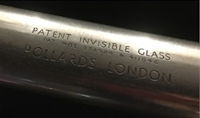
As per the Fox shop, on the hand rails on the Piccadilly-facing windows, Pollards name and 'patent invisible glass' can be found at both the extreme left and right,  rather than 'non reflecting' as per the Fox shop' along with two patent numbers can be found. 

More about Pollards in italics at the bottom.

Joseph Emberton's beautifully-designed building for Simpson has, in effect, two front doors – the southern entrance in Jermyn Street is just as impressive, implementing the same curved glass and showing that both entrances were of importance as regards customers, but I cannot find a patent mark on this side of the building:

The fourth/last London example, unless someone can tell me where to find others, is on the old gas showroom on Crouch End Broadway, today home to Barclays Bank, where double shallow curves meet and point towards us along both sides of the building. No Pollards markers to be found but there's some really nice Art Deco geometric metalwork at low level.


At high level, this building also features eight beautifully-carved panels carved by Arthur Ayres depicting the many different things that gas power could do for us.

Edward Pollard, shopfitter, company founded 1895. Listed at 134E+F Kingsland Rd, E2, as E.Pollard. 1906 moved to 29 Clerkenwell Rd. In 1913 E. Pollard & Co. designed and fitted Carreras Piccadilly shop. c1919 built a factory in Highbury. 1920s showrooms at 299 Oxford St (branches in Bristol, Manchester, Glasgow, Dublin). By 1923 E. Pollard & Co.Ltd also have second Clerkenwell premises at 158-187 St John St (Hammond+Champness lifts building, rebuilt 1925-27). 1967 Pollard Group relocated to Basingstoke.

UPDATE: see the comments for reference of similar curved glass at HMV, 363 Oxford Street, which I have written about separately here. 

UPDATE 2: A photo of the Piccadilly store shortly after it opened can be found in Art Deco Style by Hillier and Escritt. Here is crop of the street level area of that image:

It seems to show curved pairs coming forwards as at the other locations, and I am now thinking that the deep curve we see there today, that swoops away from us, was installed at a later date. Intriguing.

14 May 2021

Thomas Heatherwick's lift buttons at Coal Drops Yard, NC1

I have been having a tidy up and found some photos I took soon after the coal drops at the rear of Kings Cross station, adjacent to Granary Square, were opened as a shopping and leisure zone back in October 2018. It's impressive and a clever re-use of space, although the shops do sell a lot of over-priced guff, but it's great for a wander about.

I was there again last month with a friend, enjoying the peace and quiet and the lack of people, and I showed her the delightful surounds around the push buttons for the lifts. She loved them too.

Cool huh. Probably my favourite thing thee.

Going up.... ground for perfumery, stationery and leather goods...

10 May 2021

Colourful houses in Falkland Road

Here's another riot of colour. Last week it was bollards, this week it's houses:

The western end of Falkland Road in Kentish Town, N6, between Leverton Street and Fortess Road is one of many streets across the metropolis with a series of coloured houses. I often wonder how the owners choose what shade to use in order to either contrast or complement with the neighbours. Ker-pow!

I made a little video about it here.

6 May 2021

Bollards in Crystal Palace

Today we are in lovely South London. Well, I say that, but I took these pics well over a year ago.

As you exit Crystal Palace railway station and head to the park, do ake a closer look at the bollards in Ledrington Rd, dated 1854. The peeling paint patterns is delightful.

The tops illustrate layers of colourful history – dark green, pink, red, blue, turquoise and yellow, though not necessarily in that order.

It's about time I went back for another wander – it's a lovely part of town.

30 April 2021

Would you believe it? Wood block surfaces still visible on London streets

A few months back I was involved in an email exchange about the patch of wood blocks adjacent to Bunhill Row Cemetery, just off Artillery Row, specifically, and perhaps coincidentally (ironically?), in Chequer Street. Back in ye olde Victorian times this street ran alongside Star Works, the De La Rue postage stamp manufactory, though I don't know if this company was related to Danny. 

This little road is a patchwork of setts and cobbles and looks to have been repaired, extended or updated with various kinds of blocks. It’s probably more likely, due to the pristine condition of this area, that these were laid more recently, perhaps using blocks that were found in the vicinity and some clever person had the idea to make a feature of them. 
In addition to this patch of wood, there are also granite setts and vitreous setts, the latter being a by-product of the gas industry and said to be identifiable by their bluish glaze. Note also a couple of interesting man hole cover plates along here. It’s like a road surface nerd’s dream!

Ah, but this isn't the only patch of wood paving in the metropolis – I have happened upon quite a few other places that show hints of this eco-friendly-but-hard-to-maintain wooden surface. I've found enough to start a specific collection on my desktop and here I am sharing some of them with you... 

At 90-92 Pentonville Road N1, on the corner of Penton Street, there is evidence of a whole paved private courtyard that is currently used for car parking. Patches of wood can be seen peeking out from under the receding Tarmac. 

Research shows that this was once the display forecourt outside the ground floor showroom of R. W. Wilkins & Son, marble, granite and stone merchants, monumental masons, sculptors, table-top manufacturers, shopfitters, and interior decorators in marble and tiles. This had originally been constructed as three Georgian houses with deep front gardens, mirroring those across the road, and was converted into one premises in the 1860s by Henry Webb Wilkins, probably RWW's father. The rectangular blocks appear to be the same shape and size as the ones at Chequer Street. 

Many good remnants of wood block can also be found nestling within the segments of some old manhole and utility covers. Fir instance, just east of here, near the border of Islington and Hackney (when this was Finsbury and Shoreditch, respectively) there are examples in Mora Street on the southern side of City Road:

 
And on the other side of City Rd in Shepherdess Walk on the northern side. My pics were taken on a rainy day but, believe me, there's wood under them there puddles:

There's another example not far from there in New North Road, at the end of Wharf Road by the Royal Mail depot, and another on Clerkenwell Rd at the end of Leather Lane (centre pic below)**. Plus a couple in West Square, Lambeth, a well-to-do 1790s development of private houses, one of which is shown below right:

In the middle of Grays Inn Road at the junction of Acton Street by the zebra crossings, there is a superb example, as shown below, top left, with the streetscape below it. And there are two more good examples in Islington High Street as shown below, middle and right – one set within the pavement near Pizza Express (middle pics), another in the road at the rear of the former electricity transformer station and tram depot (top right). A third one, by the southern door to that building, at the corner of Duncan Street, sort of facing The York pub, has been recently covered in Tarmac (bottom right).  

Update: The Grays Inn Road pic shown above was taken in 2021. This cover plate was subsequently covered in Tarmac, but in April 2024 I noticed that the surface has worn away to reveal how the pieces of woodblock within the segments are now much smaller. Hmmm, how very strange. I wonder if someone tried to remove the wood blocks and then replaced them after they'd discovered that the chunks did not come out complete. See right.

I'd really love to experience the sound of horses walking on a wood-blocked street. The super-informative Roads Were Not Built For Cars shows us that Bartholomew the cartographer, produced road surface maps of London where streets coloured yellow denoted wood, green indicated sheet asphalt, blue was setts, and pink for macadam (a pre-cursor to Tarmac). The rationale that wood blocks offered the benefit of a quieter environment explains their implementation in residental streets such as West Square and in the old hospital zone around City Road.

The same 'quiet' effect would also apply at this next location – the rear of City Hall, on Belvedere Road, built as the London County Council's head offices in 1911 and, hence, a really busy municipal street. 

Here, long wooden oblongs, arranged in a grid format, have been uncovered for many years. Whenever I am in the Waterloo area I often go to check they are still visible. The random piece of flat metal is, I suppose, an attempt at protection.

Update July 2021: due to the wet weather, the woodblocks in Artillery Row are framed in grass. I think it’s lovely.

Update August 2023: I have set up the London A-Z Directory of Woodblocks. If you can add to the list, please leave a comment under this blog post or email me at jane@janeslondon.com

**Update re the Leather Lane manhole – the man hole cover within the road junction at the end of Leather Lane has now gone due to recent resurfacing of Clerkenwell Road. However, another manhole cover outside No.83, set in the pavement by the lamp post has tiny bits of wood block visible around the edges. 


27 April 2021

A stinkpipe in Islington

Oh my god... how many time have I walked past this and never noticed it until last month?

Estimate = 825 times!

I am always banging on about how things are hiding in plain view, to look up, look down and around you,  yet here's me not noticing a stink pipe across the road from Essex Road Post Office. 

I happened to notice it when I had to side-step a woman who was texting and walking but not looking where she was going (grr!) and I was immediately confronted by the maker's name on the metalwork. I then looked down at the wide base and thought, ooh that looks very stinkpipey, and so I stepped back to take a better look. Yep!

Much of Ham Baker's Victorian metal street furniture, in the form of lamp posts and stink pipes, still lines our modern streets. Indeed the company is still trading.

Considering the amount of stink pipe pics I have taken over the years I am surprised I have posted more about them. Here's a post from back in 2010 which shows some with attractive crowns. 

Staying in Islington, earlier this year, I also [finally] noticed another stink pipe at the Holloway end of Liverpool Road on the triangle in front of the Baptist church – estimated previous walk-pasts = 384(!). And, near that, there's also another one on Holloway Road at the end of Eden Grove (which I had spotted ten years ago).  Closer to my home, there's one up near the railway line in Sussex Way, N19, at the corner of Hatchard Rd, and another on St John's Way, N19. I'm sure I will think of more once I hit the 'publish' button here, but hey, that'll do for now.

This Essex Rd pipe will now form part of my "The Only Way Is Essex Road" guided tour. Tho, it can't be the only one in the vicinity.


23 April 2021

Finsbury Park Art Deco – the renovation of Oxford House


I'm so pleased to see how the renovation of this marvellous link to the world of movie making has evolved.

This is the former home of Kay Film Printing – a film processing company based here in Oxford Rd, N4, adjacent to Parkland Walk and Finsbury Park.

Its now almost finished and it looks marvellous. I really love those 'Jazz Age' style railings.

Pic from 2014 – retrospective Google Streetview

It's gone from a sad-looking building to a marvellous example of 1930's splendour.

Happy days. I am not sure how to include this on my Art Deco tour of the area but it's sure to be included on one of my walks. 


18 April 2021

Saloons – Everyone's gone to the pub or the hairdresser

Here in the UK, some restrictions as regards social distancing have been lifted – pubs with outdoor table space are open again and hairdressers are busy attacking our lockdown barnets*

It occured to me that both are historically linked by the word 'saloon' so I've pulled some pics together in my old montage-stylee showing a selection of lovely signage across London.

Most of these are pub signs but, as you can see, some are on hairdressers and barbers. Perhaps you recognise some of them or know of some other beauties...?

The separate rooms for saloon, lounge, public, private, snug and offsales is a thing of the past these days, harking back to a Victorian era of class and gender segregation. However, a few pubs in London still have the original walls/dividers and others have reinstated them. This latter section includes The Princess Louise in Holborn, the Fitzroy Tavern in Charlotte Street and the Angel at Rotherhithe. 

Never mind sitting outside a pub; that's just not for me. I am looking forward to getting back inside; to stand at a bar or sit on a barstool; to read a newspaper in a comfy chair by a real fire; to talk to barstaff and locals... sigh.

Barnet Fair = hair (London Cockney rhyming slang)

7 April 2021

I have been otherwise occupied

Oh my good... look at the date on my last post – the middle of January!!  And now we are fast heading for the middle of April. Whoosh! How did that happen?! 

Although I have been almost constantly collecting ideas for this site, I have been filing them away in a 'To Do' folder and can now see that I haven't actually been sharing them with you. I will make a big effort next week as there are a few good things I have noticed or been alerted to these last few months.

The thing that has kept me so busy lately has been designing, researching and hosting virtual tours (online presentations via Zoom) in lieu of leading actual guided tours on the streets being as that's still not really possible yet due to the pandemic restrictions. 

Presentations need good pics and reference, so I've been out and about in London's empty streets, wandering about in beautiful winter sunshine, snapping away with my camera to make the slides that accompany my talks. 

London is Lovely
I am really pleased how the presentations are going – lots of people come back to me time and again, and from all over the world – how lovely. And I will continue to do these going forward.

Find out more about my tours and talks at www.janeslondonwalks.com or simply click here for the upcoming schedule which gives more info about each one.

13 January 2021

You need hands

Inspired by the pointing hands in a recent post, I have collected some more hands that please me. 

You might recognise some of them.

The centre pic was taken at the lights festival that usually happens around Canary Wharf in January. I use it for my Facebook avatar sometimes.


7 January 2021

On the tiles at Doulton Lambeth

Happy January everyone.

Let's start the year by looking at some gorgeous tiles.

If you walk five minutes from the south side of Lambeth Bridge and head down Black Prince Road, you will see a Victorian Gothic masterpiece coming in to view. This was once the ofiices and manufactury of Doulton, Lambeth, later to become Royal Doulton.

At the time this building was constructed, Doulton's style was earthy blues and ochres, with the emphasis on good quality workmanship. This is evidenced on the building itself which is cleverly designed to be a street-facing advertisment, showing off a cross-section of some of the syles of designs that were on offer at that time, both glazed and unglazed. Beautiful examples are arranged around the windows and doors as well as higher up the building. Sadly the letters thet spelled the comapny's name have been chipped off. I know not whay, or where they might be now. Do stop for a closer look next time you are in the area.

I have created this montage of the tiles that run underneath the street-level windows (not shown in the pics above) – they look marvellous all together – tiletastic!

I've written about Doulton's work at other locations here.


9 December 2020

Twinking Trees, Turkey and Traditions – A Covent Garden Christmas Tour

Ding dong merrily – mince pies at the ready – time for a bit of self promotion.

I have turned my Covent Garden Christmas lights tour into a virtual experience – Find it here.

More dates to be added through to 6th January. See the schedule here.

I'm also more than happy to lead the tour on foot – please do get in touch.

1 December 2020

Construction Time Again – rebuilding Central London

Travelling through Central London recently, admiring the view from the top deck of a bus, I couldn't help but notice the huge redevelopments are happening at the moment and how many gaping great holes there are in the ground. Covid-19 does not appear to have restricted the construction industry.

For instance, at New Oxford Street, just east of Centrepoint, there is a big whole where this has been demolished – there is now a completely clear view of Renzo's horrible coloured towers.

Turning the corner into Charing Cross Road, the new build around Tottenham Court Road station continues. Chunky great glass things replace the much-missed Astoria Theatre (which was my favourite live music venue) and other buildings and small streets in the vicinity. The huge glasshouse entrances to TottCtRd station still look out of place and out of alignment with their tall neighbour and it's evident that the glass within them has yet to be cleaned. Such a silly design – how could you clean them anyway?  Why do these things need to be so tall and ugly? Consider  and compare the flamboyant yet understed Metro entrances in Paris.

Keep travelling with me here. Buildings between Centrepoint and Denmark Place have evolved considerably of late. Denmark Street as a centre for live music has diminished considerably and Tin Pan Alley is no more. Opposite, on the corner of Manette Street, the pink-faced replacement for the Foyles building looks to be almost complete. Hurrah, at least, for the elegant beauty of the 1930s Central School of Art, now Foyles new home.

Don't get me wrong, I am not against change, I like to see the patchwork of history – all this knock down and replace is nothing new. Leases expire, buildings become unfit for purpose etc and need to be replaced. The Victorians, and the Georgians before them, rebuilt whole streets and, just pre-WWII there was another construction boom, but the amount of change happening at the moment in Central London is, for me, quite shocking. 

And so we continue to Cambridge Circus and turn right into Shaftesbury Avenue. All looks to be as was until crash bang boom, the whole of the block behind Piccadilly's iconic advertising hoardings has been reduced to just that – an almost two-dimensional sign:

And, so, over into Piccadilly itself. Nothing to report until we get to the Ritz. There is a big development with Caffe Nero on the corner here is covered in plastic, I know not why, and then further along at the corner of Half Moon Street the red brick building's façade is all that remains. Though, as you can see from this older streetview there have been hoardings around it since at least 2008; it had been in a poor state for decades.

I decided after that to just look left at the park

It's just occured to me that I have efffectively taken you on a free virtual tour!


28 November 2020

Battersea Power Station – an update on the renovations

The whole riverside stretch between Battersea Bridge and 'Vauxhall Village' is today a swathe of new build, the old power station being only one of a few old buildings left standing in the area. A while back I wrote a provoacative piece suggesting they should pull the thing down. After all, if this building is so revered how come it was left open to the elements as a ruin for decades?! I followed up my thoughts in 2013 and then again in 2014. Why has this building become the famous one when so may like it were demolished completely? Consider, for instance, that the Lots Road Power Station has been empty for decades. Does this have anything to do with popluar culture? Pink Floyd? Or is it that the site was so huge that no-one was prepared or could afford to take it on?

A few weeks ago on one of those lovely bright, crisp, sunny, winter days, I had an urge to walk along the river from Battersea to Waterloo* and this afforded me the opportunity to have a nose in at the what's happening. It was a glorious day and everthing looked marvellous. And there were hardly any people about. And it was quiet. And I like it like that.

I followed the Thames Path into the main area of new build at the side of the railway arches filled with restauarants and food outlets but closed for business due to Coronavirus. Just a few people about, walking their dogs and enjoying the sunshine. I wandered around for over an hour and exited the site via Nine Elms Road where this old electrictity box sits.

Do go and have a wander through yourself. There is one-way pedestrian route through the site. Bear in mind that there are still a lot of buildings yet to be started and these will, as I mentioned in my earlier piece, obliterate the view from the Wandsworth side. So I'd advise you get there while the main building is still visible.

A nice addition is the old coaling jetty which has been tranformed into a decked garden complete with seats and flowers and excellent views, but at the moment it's only one way in and the same way out again. I hope that this will be connected to the Thames Path in due course. Note the dockers' mistresses along the edge the looking like topless sunbathers who have got a bit burnt. More here.

Adjacent to the jetty they've installed lots of low level planting and strange triangular raised ponds which offer interesting reflections of the power station. The broken reflections in the new glass buildings are also intriguing. The zig-zag walkways are a bit annoying though. I am fairly sure that people will very quickly make desire paths to cut off the pointy corners.

24 November 2020

Hornsey Road – more ghostsigns, observations and recollections

When I first moved to the Holloway area back in 1988 I lived at the eastern end of Marborough Road, near its junction with Hornsey and Hanley Roads. My bus stop back from work in the West End was the one just south of Bavaria Road at a time when the bus was a 14A and went all the way to Chelsea (what a fab, long route!). I used to like looking at the hints of history in the area but didn't look into it until many years later.  I subsequently moved to another address near to Holloway's Nags Head shopping area but I still have cause to walk the same roads, often when I am headed up to or back from Crouch End, which used to be part of Hornsey, hence the road name. 

Last month I was coming back down the hill and I noticed that the Hanley Arms, which is now an Islamic place of worship, has been given a much-needed lick of paint. It had for years been looking rather sad and I had always worried that the lovely black metalwork over the doors showing the pub name and the saloon bar would get further damaged over time or, worse, be removed comletely. As these pics show, the owners have seen fit to enhance in gold paint that the building was once a pub, which seems at odds with its purpose these days.

Pics all 2020 exc bottom right showing when it was still a pub

I think the Hanley Arms entrance on the corner was for the more basic area of the pub to the Private or Public bar. The Saloon Bar at centre-front would have led to the swankiest part of the pub and there might have been a third entrance down the side that led to a smaller room at the rear. These defined bar areas for different kinds of people would have been sectioned off with wood and glass panels from a main bar area at the centre. I am vaguely aware of going in there once for a nose about when I moved to the area, or am I imagining this or getting my wires crossed with another similar pub?  Most of the interior fittings have since been removed to convert it into a prayer room but the Anaglypta ceiling and other hints of the bulding's previous life are still visible as shown here in The Hornsey Road blog.

The road has changed a lot since I arrived here. Today the eastern side is mainly fast food outlets, but I recall many more and varied shops in the late 80s. But it certainly wasn't as vibrant a street as it was 100 years before that, with shops all the way up to Hornsey Rise and down to Holloway and beyond, with pubs at almost every junction. For instance, on the opposite side of the road to the Hanley Arms was The Alexandra on the corner of Bavaria Road, then called Blenheim Road, as shown by the old painted road sign.

Bottom left 2020, bottom centre and right 2008

A panel on the side of the old pub building shows The Alexandra advertised itself as a 'COFFEE TAVERN'. I assume from this that this was a more genteel kind of place with tablecolths and attracted ladies. The pub was converted to commercial use. By the late 1980s, it was a locksmith's shop which continued to trade into the early 2000s, complete with a large advertisement for key cutting and 5-lever locks and whatnot on the north-facing side of the premises at ground level. By the time I photographed the sign in 2008 it was extremely faded. It's now completely gone having been over-painted, probably at the same time as another storey was added to the top of the building.

The coffee tavern sign reminded me that on a rainy day in 2011 I'd spotted a faded sign on at high level on No.418 that showed the feint letters LADIES SALOON. I could make out a name above ending "...ETTS" – I stupidly never returned to take better pics and it's now been over-painted. Damn.

Hornsey Road ghostsigns – NatWest Bank, Ladies Saloon, The Plough. All 2020 exc middle top.

This looks to be a late-Victorian-Edwardian establishment – a quick bit of delving shows me that Walter Betts had a coffee shop at No. 422 until 1905. By 1906 the same establishement is owned by Charles Watson. Note that the sign is not above the coffee shop but instead above what was then Emil Kober's hairdresser shop at No.418. It looks like a clever bit of inter-business was happeninging here – ladies could get their hair done and then retire to rooms on the upper floors for drinks, provided and served by the esatablishment two doors up the road. How lovely.

As you walk along the road today, you can clearly make out how this was once a busy high street with shops of every kind. As shown above, there's even the hint of a branch of NatWest and further along at the junction of Tollington Park there's what's left of The Plough public house. The entrance to the stables at the rear has been filled in for decades now and it's again one of those places I wish I'd photographed back in 1988 when the cobbled access was still viable leading to the rear of the pub.

I'll leave it there. Any extra info and memories most welcome.